
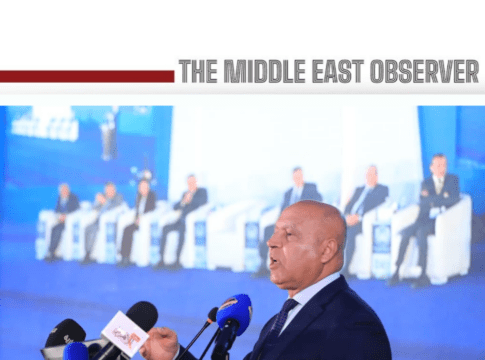
Egypt is accelerating a sweeping overhaul of its maritime transport and logistics system as part of a national strategy to position the country as a regional and international hub for transit trade, Deputy Prime Minister for Industrial Development and Minister of Industry and Transport Kamel El-Wazir said at the opening of the 15th International Transport and Logistics Conference.
El-Wazir said the programme seeks to embed Egypt more deeply into global supply chains linking the Mediterranean, the Red Sea, and Africa, under presidential directives to make logistics and maritime transport a central engine of long-term economic growth. Officials describe the strategy as a shift away from fragmented infrastructure projects toward an integrated national framework aimed at boosting competitiveness, supporting industrial expansion, and increasing transit-trade revenues, while strengthening Egypt’s role in global shipping and distribution networks.
At the heart of the plan is the development of seven integrated, multimodal logistics corridors connecting seaports on the Mediterranean and Red Sea with the Suez Canal axis, inland dry ports, logistics zones, industrial and agricultural production centres, and the national rail and express-road networks. According to ministry planning targets, the corridors are intended to streamline cargo movement across the country, reduce congestion at seaports, and create seamless production-to-export and transit routes.
The Alexandria–Mediterranean Corridor forms Egypt’s primary northern maritime gateway, anchored by the ports of Alexandria, Dekheila, and El-Max. These ports handle containerised, bulk, and general cargo and link northern Egypt’s main industrial centres to inland dry ports and logistics zones through upgraded rail and highway connections, easing pressure on coastal facilities and improving export efficiency.
Further east, the Damietta–Mediterranean Corridor is centred on Damietta Port and the New Damietta industrial and urban area. It serves as a specialised hub for container traffic, agricultural exports, and the Delta’s furniture and light-manufacturing industries. The corridor shifts cargo clearance and value-added logistics activities inland, reducing quay-side congestion and integrating Delta production more closely into regional and global supply chains.
At the northern entrance of the Suez Canal, the Port Said–Suez Canal Corridor integrates East and West Port Said with the Suez Canal Economic Zone, rail freight lines, and road networks extending toward Sinai and the Nile Delta. Its location positions it to capture transit trade, support industrial and logistics investment within the SCZone, and reinforce Egypt’s role as a global transshipment and redistribution hub.
The Ain Sokhna–Suez Canal–Greater Cairo Corridor forms the backbone of Egypt’s Red Sea trade infrastructure. Anchored by Ain Sokhna Port, it extends inland to Greater Cairo, 10th of Ramadan City, and the New Administrative Capital. The corridor provides a direct link between heavy industry, manufacturing clusters, and logistics zones and deep-water Red Sea terminals, while also serving as a critical connection between the Red Sea and the Mediterranean through the canal axis.
In Upper Egypt, the Safaga–Red Sea Corridor connects Safaga Port with governorates including Qena, Luxor, and Aswan through upgraded highways and rail lines. Designed to support mining, agricultural, and industrial exports, the corridor integrates historically underserved regions into national and global markets and lowers logistics costs by providing more direct access to Red Sea shipping lanes.
Two of the remaining corridors focus on strategic development zones beyond the core transit network. In North and Central Sinai, a corridor anchored by Arish and surrounding coastal infrastructure links ports, roads, and future rail connections to the Suez Canal axis, while supporting reconstruction and economic activity. On the western flank, a corridor centred on Marsa Matrouh connects Mediterranean ports with inland road and rail networks into the Western Desert, supporting agricultural reclamation, mining, energy, and petrochemical projects, as well as trade routes toward Libya and North Africa.
Alongside the corridor framework, Egypt is undertaking a major expansion of port infrastructure. Ministry plans envisage about 70 kilometres of new deep-water berths with depths ranging from 18 to 25 metres, enabling ultra-large container vessels, LNG carriers, and bulk ships. Once combined with existing facilities, total berth length across Egyptian seaports is expected to exceed 100 kilometres, while total port land area will surpass 100 million square metres. The programme spans ports including Alexandria, Damietta, Port Said, Ain Sokhna, Safaga, and Matrouh, underscoring Egypt’s ambition to compete with established regional hub ports.
Maritime services and sovereign shipping capacity form another pillar of the strategy. Port-modernisation plans target a fleet of around 80 tugboats, including harbour, escort, and emergency-response vessels, to improve safety, reduce vessel turnaround times, and cut reliance on foreign service providers. In parallel, Egypt plans to build a national merchant fleet of 40 vessels by 2030, with capacity to carry around 25 million tonnes of diversified cargo annually. Fully owned by entities affiliated with the Ministry of Transport, the fleet is intended to strengthen control over trade flows and reduce exposure to volatile freight costs.
The logistics programme is underpinned by a nationwide network of dry ports and logistics zones. More than 20 facilities are operational, under construction, or at advanced planning stages, with a long-term national target of 33 dry ports under Egypt’s logistics master plan. Facilities such as 10th of Ramadan, 6th of October, Borg El-Arab, Sadat City, and several Upper Egypt hubs are designed to shift cargo clearance inland, ease congestion at seaports, and reduce overall logistics costs and transit times.
The conference was attended by senior regional and international officials, including Jordan’s transport minister, Cypriot shipping representatives, and Suez Canal Authority Chairman Osama Rabie. Rabie said the canal had shown resilience despite geopolitical shocks, noting that while 2024 was heavily disrupted by the Red Sea crisis, the final quarter of 2025 saw signs of recovery as regional stability improved. Officials say the broader logistics strategy is intended to reduce Egypt’s exposure to future shocks by anchoring growth in diversified transport capacity and integrated trade corridors.desk
