
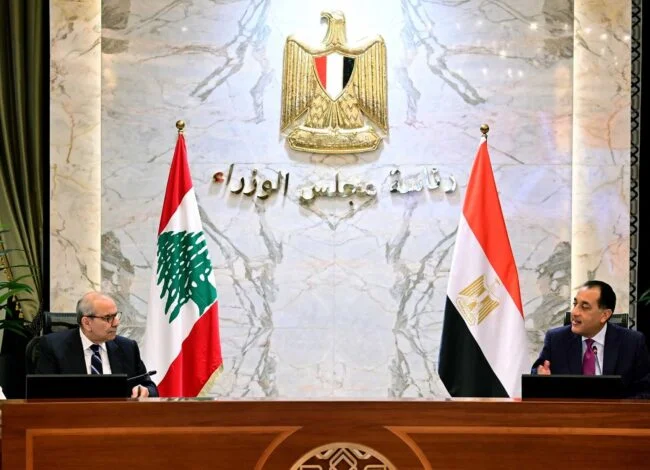
Egypt and Lebanon have signed a comprehensive package of 15 cooperation agreements designed to strengthen economic, institutional and social ties, marking a renewed phase in the relationship between the two Mediterranean partners.
The accords were formalised in Cairo at the closing session of the 10th Egyptian–Lebanese Joint Higher Committee, co-chaired by Egyptian Prime Minister Mostafa Madbouly and his Lebanese counterpart Nawaf Salam. The meeting brought together senior ministers and officials from both sides, underscoring what Madbouly described as a “shared vision for deeper integration and pragmatic cooperation.”
The new agreements span sectors from economic policy, trade, and finance to education, agriculture, and social protection. They also introduce frameworks for coordination in transport, housing, public administration, and consumer protection. Officials said the pacts reflect both countries’ intent to move from dialogue to implementation.
Under the new framework, Cairo and Beirut will coordinate economic and development policy, exchange expertise in planning and industrial modernisation, and step up cooperation in customs administration and financial oversight. A separate deal between Egypt’s Financial Regulatory Authority and Lebanon’s Insurance Control Commission aims to enhance regulatory transparency and investor confidence across both markets.
In the transport field, a bilateral maritime agreement will expand joint work on port operations and shipping logistics, while a civil aviation training protocol will connect Egypt’s Aviation Academy with Lebanon’s Directorate General of Civil Aviation to bolster workforce capacity in a sector both nations see as vital for tourism and trade.
Urban planning and housing were also central to the talks. Egypt’s Ministry of Housing and Lebanon’s Ministry of Social Affairs will cooperate on affordable-housing policy and sustainable city development, drawing on Egypt’s experience with large-scale urban projects.
Social welfare and education featured prominently. A memorandum between Egypt’s Ministry of Social Solidarity and Lebanon’s Ministry of Social Affairs will promote collaboration on social-protection programmes, while another agreement links the two countries’ education ministries to strengthen technical and vocational training systems—an area identified as critical to job creation and youth development.
Agriculture and research ties were reinforced through a partnership between the two agriculture ministries focusing on innovation, food security and climate-resilient farming techniques.
The committee also approved a protocol between Egypt’s Central Agency for Organisation and Administration and Lebanon’s Civil Service Council, aimed at upgrading public-sector governance and capacity-building. A draft memorandum on reciprocal visa exemptions for diplomatic passport holders is expected to simplify official exchanges and support ministerial cooperation.
At the close of the session, both prime ministers signed the official record of the committee’s proceedings, pledging to expedite implementation and maintain follow-up mechanisms. The agreements come as Lebanon seeks post-crisis recovery and Egypt pursues broader regional economic partnerships.
Officials described the outcome as a model for South–South cooperation, linking two economies that share similar development challenges and opportunities. Analysts say the success of the framework will depend on execution—turning memoranda into measurable results in trade, training and institutional reform.