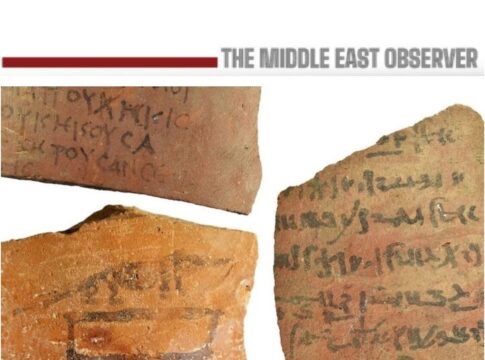
Sohag — An Egyptian–German archaeological mission has uncovered around 13,000 inscribed pottery fragments, known as ostraca, at the ancient site of Athribis archaeological site in Upper Egypt, providing new insights into daily life, administration, and religious practices over more than a millennium.
The discovery was made during the latest excavation season by a joint team from Egypt’s Supreme Council of Antiquities (SCA) and University of Tübingen in Germany. With the newly recovered material, the total number of ostraca found at Athribis has reached approximately 43,000, making it the largest collection of inscribed pottery fragments discovered at a single archaeological site in Egypt, according to Hisham El-Leithy, Secretary-General of the SCA.
Researchers say the inscriptions document a wide range of everyday activities, including tax payments, delivery orders, administrative lists, accounting records, and writing exercises used by students. Some texts also relate to religious life, featuring hymns, prayers, and references to temple activities.
According to excavation director Markus Müller, the inscriptions appear in several scripts and languages, reflecting the diverse administrative and cultural history of the settlement. Most of the texts are written in Demotic script, representing roughly 60–75% of the finds, while Greek accounts for about 15–30%. Smaller portions appear in Hieratic, Hieroglyphic, Coptic, and Arabic, alongside fragments bearing drawings or geometric symbols.
The ostraca discovered at the site cover an extended historical period. Christian Leitz, the German co-director of the mission, explained that the earliest texts include tax receipts written in Demotic dating to the third century BC, while the most recent examples are jar labels written in Arabic from the ninth to the eleventh centuries AD. Egyptian archaeologist Mohamed Abdel Badie, who leads the Egyptian side of the project, noted that more than 42,000 ostraca have been uncovered during the past eight years of excavations at the site.
Among the most notable discoveries are more than 130 texts related to astrology and zodiac traditions, primarily written in Demotic and Hieratic scripts. Scholars believe these texts may shed light on ancient Egyptian approaches to astrology and ritual practices.
The newly discovered material is currently being studied under the “Ostraca d’Athribis” research project, an international collaboration led by Sandra Lippert, which has been examining the inscriptions and ceramics since the 2018–2019 excavation season to better understand the economic, administrative, and religious life of the ancient settlement.
Located near Sohag in the village of Nagaa El-Sheikh Hamad, Athribis was historically part of the ninth administrative district of Upper Egypt, whose capital was the nearby city of Akhmim.
In antiquity, the city served as a major centre of worship for the lioness goddess Repyt, who formed a local religious triad with the fertility god Min of Akhmim and the child deity Kolanthes.
Archaeologists say the growing corpus of ostraca from Athribis is providing one of the most detailed documentary records yet discovered for an ancient Egyptian urban settlement.