Egyptian archaeologists have uncovered the remains of a fully integrated Byzantine-era monastic complex in Sohag Governorate, offering rare and detailed insight into early Christian monastic life in Upper Egypt and reinforcing the region’s growing importance on Egypt’s archaeological map. The discovery was made by a mission from the Supreme Council of Antiquities at the site of Al-Qarya Al-Duweir in the Tema district, where ongoing excavations revealed a cohesive residential and religious settlement dating back more than 1,500 years.
The complex consists of multiple mudbrick structures arranged according to a clear architectural plan, indicating that the site functioned as a self-contained monastic community rather than a loose grouping of dwellings. Egypt’s Minister of Tourism and Antiquities Sherif Fathy said the discovery reflects the depth and diversity of Egypt’s cultural heritage across successive historical eras, noting that such finds help spotlight lesser-known archaeological areas and support efforts to diversify cultural tourism beyond traditional destinations.
According to Mohamed Ismail Khaled, Secretary General of the SCA, the excavation provides valuable scientific evidence about the organisation of monastic life during the Byzantine period. Preliminary analysis suggests a structured daily routine and spatial hierarchy, pointing to a settled religious community with defined functions for worship, residence, and communal activity.
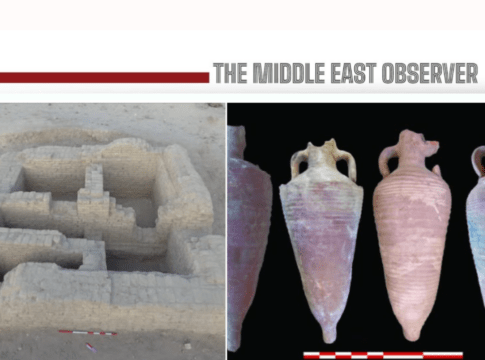
Architectural details reveal carefully planned buildings oriented along a west–east axis, with dimensions ranging from modest monks’ cells to larger communal spaces. Mohamed Abdel-Badei, head of the Ancient Egyptian Antiquities Sector, said the mission uncovered rectangular halls, some featuring apses or niches likely used for prayer, alongside small vaulted rooms believed to have served as individual cells. The structures preserve traces of plastered walls and floors, with visible niches and recesses, while some buildings open onto southern courtyards and include circular installations thought to have functioned as communal dining tables.
The excavation also identified infrastructure linked to daily and practical needs, including brick-and-limestone basins coated with red plaster, which archaeologists believe were used for water storage or light industrial activities connected to monastic life. At the heart of the complex lies a large mud brick church measuring roughly 14 by 10 metres, interpreted as the main place of worship. The church features a nave, choir, and semi-circular sanctuary, flanked by side chambers, with evidence of mud brick pillars suggesting it was once crowned by a central dome.
Artefacts recovered from the site further illuminate the spiritual and economic life of the monks. Mission director Walid El-Sayed said finds include storage amphorae bearing inscriptions that may represent names, numbers, or administrative markings, along with numerous ostraca inscribed in Coptic. Additional discoveries of domestic tools, architectural stone fragments, and limestone panels carved with Coptic texts strengthen the interpretation of the site as an active and literate religious community.
Together, the architectural remains and artefacts provide one of the clearest archaeological windows yet into Byzantine monastic settlement patterns in Upper Egypt, underlying Sohag’s emergence as a key area for discoveries that broaden understanding of Egypt’s Christian heritage alongside its Pharaonic past.