
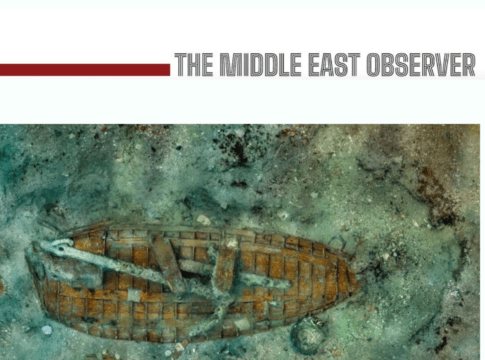
Archaeologists have uncovered a rare ancient Egyptian pleasure boat off the coast of Alexandria, closely matching descriptions recorded by the first-century AD Greek historian Strabo, according to reports cited by The Guardian.
The vessel, measuring around 35 metres in length, dates back to the first half of the first century AD and was designed to accommodate a central superstructure with a lavishly decorated cabin, indicating its use by elite passengers. The discovery sheds new light on the opulence of ceremonial and leisure life in ancient Alexandria during the Roman period.
The boat was found near the now-submerged island of Antirhodos, once part of Alexandria’s vast ancient harbour complex known as Portus Magnus. Antirhodos was historically associated with royal and administrative functions, strengthening interpretations that the vessel was used by members of the ruling elite.
Strabo, who visited Alexandria between 29 and 25 BC, described such vessels as richly furnished boats used by the royal court and festival-goers travelling through canals linking the city to public celebrations. He wrote that the boats were filled day and night with music, dancing and revelry, offering a vivid account that aligns closely with the newly discovered vessel.
The excavation was conducted by the European Institute for Underwater Archaeology (IEASM) under the direction of renowned maritime archaeologist Franck Goddio, a visiting professor at Oxford University. The find adds to a growing body of underwater discoveries that continue to reshape understanding of Alexandria’s submerged ancient landscape and its role as a major Mediterranean centre of power, culture and luxury.