The world’s media has rarely shared such a collective sense of admiration, curiosity, and anxious excitement as it does today for Egypt’s long-awaited Grand Egyptian Museum (GEM). Set dramatically on the Giza Plateau, in full view of the ancient pyramids, the museum has become a modern legend even before its official opening—hailed as “the world’s largest archaeological museum dedicated to a single civilization” by Smithsonian Magazine and celebrated by Condé Nast Traveller as “a once-in-a-generation cultural event.”
The idea of the Grand Egyptian Museum began in the 1990s, born of Egypt’s ambition to create a global beacon of heritage that bridges the ancient and modern worlds. In 2002, under the auspices of UNESCO and the International Union of Architects, Egypt launched an international competition to design this monumental structure. The winning concept, by Heneghan Peng Architects of Ireland, envisioned the museum as the point where the rays of the sun—rising from the peaks of the three pyramids—meet at a conical summit: the Grand Egyptian Museum itself. Construction began in 2005, followed by the establishment of the largest restoration center in the Middle East in 2006, inaugurated in 2010, which international experts have since praised as “a scientific and conservation marvel.”
Recognizing the museum’s magnitude, the Egyptian government established the Grand Egyptian Museum Authority in 2016, reorganized by Law No. 9 of 2020 under the supervision of the Minister of Antiquities. Its Board of Trustees, chaired by the President of Egypt and including global experts and cultural leaders, reflects international governance standards admired by institutions like UNESCO and ICOM. Global observers have described this governance model as “a testament to Egypt’s intent to balance national pride with international best practice.”
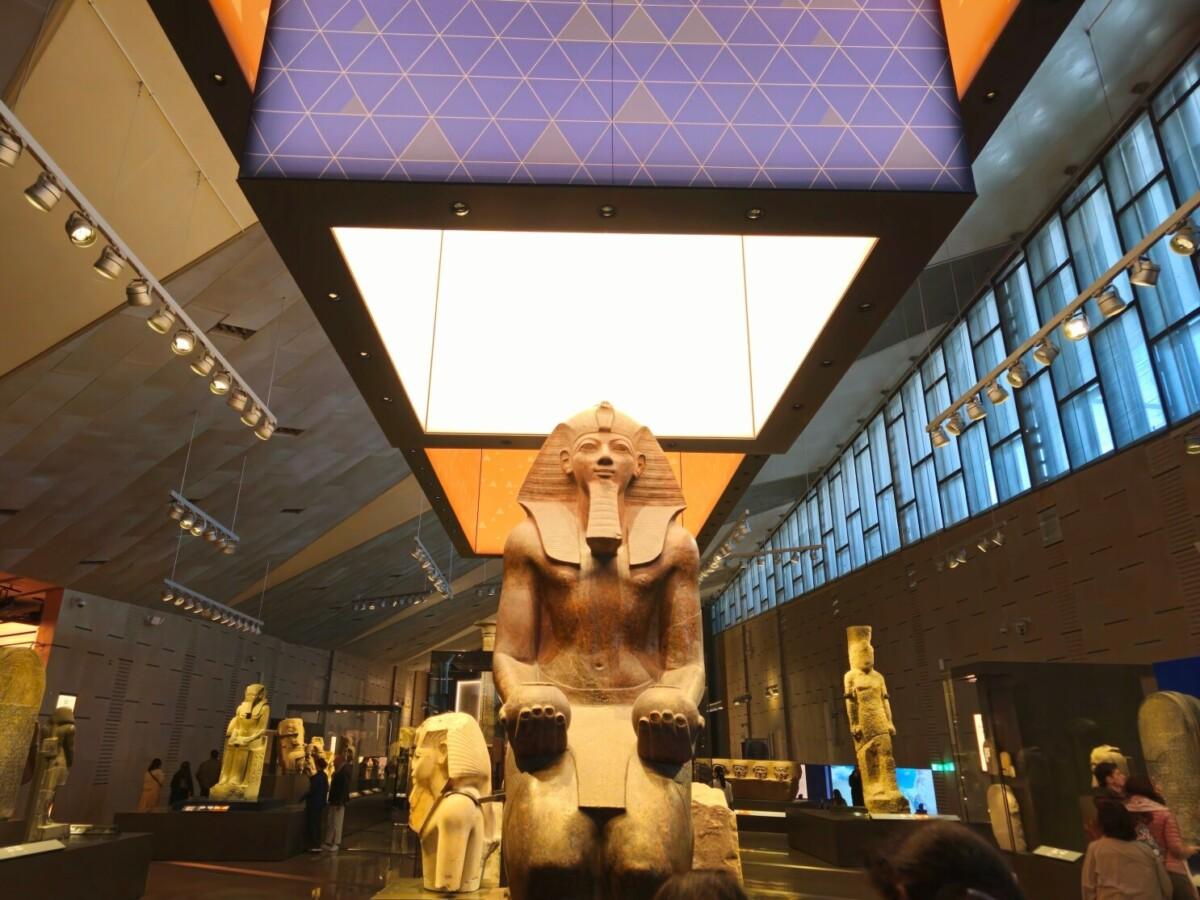
By 2021, the 300,000 m² complex stood complete—a contemporary masterpiece of glass, light, and geometry. National Geographic called it “a modern wonder overlooking the ancient ones,” and France 24 praised its scale as “larger than life, in both ambition and spirit.” Inside, vast galleries await over 100,000 artifacts, including the full treasures of Tutankhamun, displayed together for the first time since Howard Carter’s discovery in 1922. Other highlights include Queen Hetepheres’ treasures, the Khufu Boat, and relics from Egypt’s prehistoric period through Roman eras.
Foreign media outlets—from The National (UAE) to The Japan Times—have focused on GEM’s broader significance: a rebirth of Egyptian tourism and cultural diplomacy. The museum is not just a showcase of relics, but a global learning destination featuring a Children’s Museum, Education Center, cinema and conference halls, artisan workshops, and landscaped cultural plazas. In 2021, a visitor-services contract was awarded to Hassan Allam Alliance, a consortium including international firms specializing in hospitality and marketing—praised by Reuters as “a sign that Egypt intends the museum to operate at world-class standards from day one.”
International outlets have marveled at GEM’s integration of advanced digital documentation and interactive museology. AFAR Magazine highlighted the museum’s “state-of-the-art conservation labs rivaling those in Paris and London.” Digitization initiatives ensure that each artifact is secured, catalogued, and interpreted for both academic researchers and the visiting public. Beyond exhibitions, GEM will host conferences, workshops, and cultural events, reaffirming Egypt’s role as a living center of learning, not merely a custodian of the past.
As Egypt prepares for the official opening scheduled around 1 November 2025, the international mood blends exhilaration with a touch of nervous suspense. The Guardian referred to it as “a countdown of global proportions,” while The Sun—in its more dramatic fashion—spoke of “a billion-dollar dream finally awakening under the Giza sun.” The world’s journalists, influencers, and travelers share a collective hope that this monumental cultural event will redefine the museum experience itself.
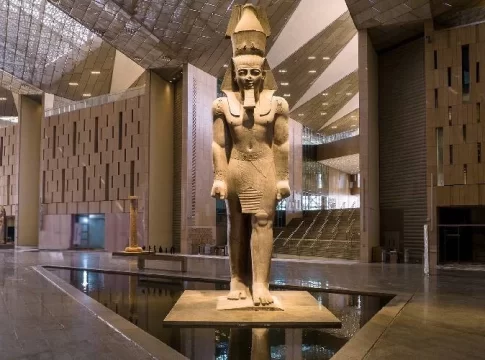
Already, limited guided tours give visitors a tantalizing preview—through the Hanging Obelisk Plaza, the Grand Hall, and the Ramses II statue that greets all who enter. Yet the main galleries, the Grand Staircase, and the Tutankhamun Hall remain closed, their unveiling reserved for opening day—a strategy Reuters described as “teasing the world’s curiosity to its highest point.”
When the red ribbon is finally cut, kings, presidents, and cultural icons are expected to gather in Cairo for a ceremony unlike any in living memory. For now, the world watches with admiration and anxiety—eager for the moment when the past and the future, the pyramids and the glass façade, meet in harmony under Egypt’s eternal sun.
In the words of Time Magazine: “The Grand Egyptian Museum is not just Egypt’s gift to the world—it is the world’s mirror, reflecting the timeless brilliance of human civilization.”