
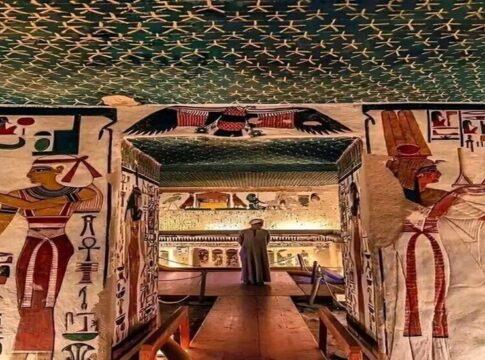
After more than 20 years of painstaking work, Egypt has officially reopened the tomb of Pharaoh Amenhotep III, one of the largest and most artistically significant in the Valley of the Kings, to the public. The unveiling represents not only a restoration triumph but also a message of cultural renewal ahead of the Grand Egyptian Museum’s inauguration.
Discovered in 1799 and long stripped of many of its original contents — including its sarcophagus — the tomb has been stabilized and refurbished through a three-phase Japanese-led project in cooperation with UNESCO and Egypt’s Supreme Council of Antiquities. According to Mohamed Ismail Khaled, the restoration involved “incredibly delicate work” to rescue wall paintings and structural elements suffering from deterioration.
The tomb lies beneath a 36-metre downward sloping corridor carved into a hillside on Luxor’s west bank and includes a main burial chamber for the king and side chambers for Queens Tiye and Sitamun. Although the tomb is not fully decorated, its surviving murals depict Amenhotep III receiving life from Egyptian deities, and inscriptions from the Book of the Dead guide his journey through the afterlife.
At the inauguration, Tourism and Antiquities Minister Sherif Fathy underscored that the project reaffirms Egypt’s commitment to preserving its heritage and signals Luxor’s indispensability in global archaeology. Nuria Sanz, UNESCO regional director, said the restoration adhered to “super highest standards of integrated conservation,” and involved over 260 specialists in restoration, research, and technical work.
The reopening comes just ahead of the Grand Egyptian Museum’s planned launch on November 1, as Egypt pushes to revitalize tourism and showcase its ancient treasures.
Among the restored features is the granite sarcophagus lid, now repositioned in its frame though too heavy to move. The conservation work also included cleaning pigments, consolidating plaster, shoring columns, and installing monitoring systems to safeguard against future damage.
While many of the tomb’s original contents were removed or looted centuries ago, its renewed accessibility provides scholars and visitors alike a fresh window into the art and theology of the Eighteenth Dynasty. The reopening marks a vital step in Egypt’s broader mission to balance conservation with public access and to restore global confidence in heritage site management.