
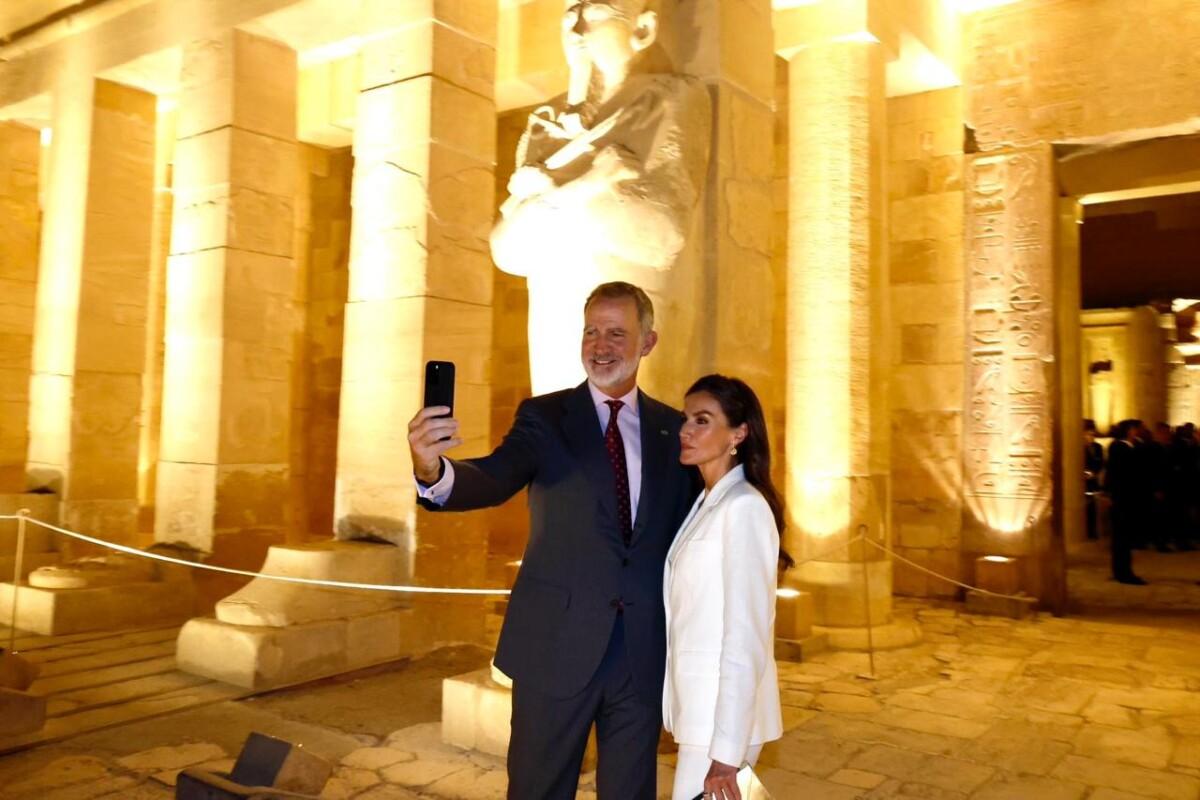
The night air over Luxor was heavy, the kind of heat that presses on your skin even after the sun is gone. The Nile slid past like a black ribbon of oil, silent, ancient, unbothered by centuries of kings and conquerors. Into this charged quiet stepped King Felipe VI and Queen Letizia of Spain, their four-day state visit to Egypt winding toward its conclusion not with politics in Cairo, but with something older, darker, more eternal: the ghosts of Luxor.
They came not as tourists, not really, but as witnesses. The royals walked the same paths that once bore the sandals of priests and the blood of slaves. Their shadows fell against the colossal stones of the Temple of Hatshepsut, suddenly alive under a brand-new Spanish-engineered night-lighting system. The floodlights carved the temple into sharp relief, like a stage set built for the gods. For a moment, the queen tilted her head upward and the carved faces seemed to stare back, awake after three thousand years.
Beneath the new light, history itself seemed restless. Egyptian officials spoke proudly of cultural cooperation, of Spain’s hand in preserving this world heritage. But the air carried a different voice too, faint and insistent — the whisper of granite that had seen kingdoms rise and fall.
Into the Tombs
The next morning, the royals descended into the Valley of the Kings, where stone corridors tunneled into silence. The tombs of Ramses V, Ramses VI, and Seti I received them like a hush in the earth, walls painted with gods and demons frozen mid-stride. Even the electric lights couldn’t chase away the weight of centuries pressing from the rock.
Here, Spanish archaeologists took their turn as guides. They spoke of pigments that refused to die, of curses woven into hieroglyphs, of discoveries pulled from the dirt like bones from a wound. The visitors nodded, yet one sensed that everyone felt the same uneasy truth: this wasn’t merely a tour. It was trespassing, politely sanctioned.
The Living Dead of Dra Abu el-Naga
Later came the Djehuty Project, a Spanish mission two and a half decades in the making. In the sands of Dra Abu el-Naga, they had uncovered funerary monuments that spanned four periods of Egyptian history. Each tomb had its story — some of scribes, others of warriors, some nameless, their bones arranged like puzzles with missing pieces.
Standing before one excavation pit, King Felipe scribbled his name into the guest book of the Winter Palace Hotel: “A wonderful stay in Luxor at the Winter Palace. We hope to come back. Spain and Egypt are so close.” His handwriting was neat, the message diplomatic. But behind those words, perhaps, a flicker of unease: closeness to Egypt meant closeness to the grave.
Spain’s Shadow in Egypt’s Sand
For decades, Spanish archaeologists have burrowed into Egypt’s soil — conserving, restoring, cataloguing. The Temple of Millions of Years of Thutmose III lies partly under their protection, its chambers coughing up secrets thought long lost. Even the new lighting at Hatshepsut’s temple bears their mark, a Spanish gift wrapped in LEDs and fiber optics.
The Egyptian government calls it cultural cooperation. But in Luxor, where every stone breathes history, cooperation feels more like possession — two nations sharing not just policy, but ghosts. And the more they shine their lights, the more shadows stir in the corners.
A Visit That Echoes
When the royal couple boarded their plane back to Madrid, Luxor was quiet again. The tombs closed their mouths, the temples folded back into dusk, the Nile resumed its endless whisper. Yet something lingered. Egypt and Spain had written another chapter in their shared story, a tale of diplomacy wrapped in archaeology, of tourism gilded with ghosts.
And in the darkness beneath the Valley of the Kings, the painted eyes of Seti, Ramses, and Thutmose watched. They had seen kings before. They would see kings again. The royals departed; the pharaohs remained.
Because in Luxor, the past never sleeps.