
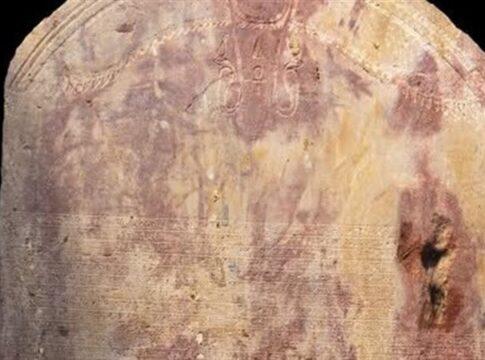
Egypt’s Supreme Council of Antiquities has announced the discovery of a rare sandstone stela inscribed with the Canopus Decree of 238 BCE, found at the Tell el-Pharaeen site in El-Husseiniya, Sharqia Governorate. The find is remarkable because it represents the first hieroglyph-only version of the decree, a text previously known only through six other copies that were written in trilingual form—hieroglyphic, Demotic, and Greek. Scholars describe the new stela as the first intact example uncovered in over 150 years, adding a seventh copy to the known corpus.
The decree, issued by Egyptian priests in honor of King Ptolemy III Euergetes, celebrated the ruler and his family while codifying important religious rituals and introducing a pioneering calendar reform. Earlier discoveries of the Canopus text—at San el-Hagar (Tanis), Kom el-Hisn, and Bubastis (Tell Basta)—were vital in understanding the priestly decrees of the Ptolemaic period. Yet unlike those trilingual copies, the Sharqia stela offers a pure hieroglyphic rendering, which Egyptologists believe will provide fresh opportunities to refine interpretations of royal titulary, ritual phrasing, and linguistic conventions.
Officials have not yet released full technical specifications of the artifact, and early reports differ on its size—ranging from about 1.2 meters to over two meters in height—underscoring the need for detailed epigraphic documentation. Archaeologists confirmed that the stela was unearthed in situ at the ancient city of Buto (Imet), a key Delta center with deep religious and cultural importance. The SCA is expected to conduct full conservation and digital scanning before publication and display.
Beyond its academic value, the find aligns with Egypt’s broader cultural and economic strategy. As the long-awaited Grand Egyptian Museum prepares for formal opening in November 2025, the discovery adds momentum to Egypt’s positioning as both a guardian of heritage and a global tourism destination. Recent analyses by the World Travel & Tourism Council project international visitor spending to reach EGP 768 billion in 2025, with cultural tourism expected to play a leading role in shifting demand from volume-based sun-and-sea packages to higher-yield cultural itineraries. Officials view headline discoveries such as the Sharqia stela as crucial to sustaining this narrative.
For scholars, the decree offers a parallel to the famous Rosetta Stone: while the Rosetta text was key to unlocking hieroglyphs through its trilingual format, the new Canopus stela allows researchers to examine the decree in an unmediated hieroglyphic form. This could sharpen comparative studies of priestly decrees and expand understanding of Egypt’s Ptolemaic administration. For Egypt’s economy, it provides another cultural asset with the potential to be showcased in exhibitions, publications, and global partnerships—strengthening the country’s heritage economy and tourism appeal as it enters the final quarter of 2025.