
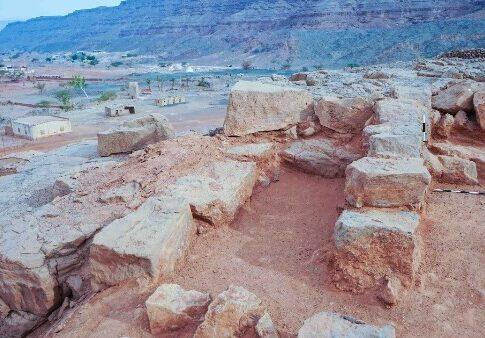
Archaeologists in Egypt have uncovered a remarkably preserved copper smelting workshop, administrative buildings, and lookout points at the ancient mining site of Wadi El-Nasab in South Sinai, providing rare insight into how the pharaohs transformed the desert into one of the world’s earliest industrial landscapes.
According to the Supreme Council of Antiquities, the site was active from the Old Kingdom through the Late Period, peaking in the New Kingdom, and the newly revealed furnaces, slag heaps, ingots, crucibles, and tuyère heads demonstrate an advanced metallurgical system capable of producing copper on an industrial scale.
Analytical studies of slag from Wadi El-Nasab suggest smelting temperatures between 1,180 and 1,350°C were achieved using charcoal from local trees, with air forced through clay nozzles (tuyères) connected to bellows or blowpipes—technology that marks a leap from simple pit furnaces to more sophisticated shaft furnaces.
Mission director Hesham Hussein said the complex “was not just a mine but an industrial hub,” while Egyptologist Salima Ikram noted that copper was the “backbone of Egyptian tools and weapons,” and turquoise from the same valleys held symbolic power in temple and burial practices.
The discovery also revealed evidence of state-level organization, including administrative structures and lookout posts, underscoring Sinai’s strategic role as both a mineral frontier and an extension of Egyptian authority.
Tourism and Antiquities Minister Sherif Fathy stressed that the site reflects how ancient Egyptians managed resources in ways that “resonate with today’s concepts of sustainable development.”
With slag deposits estimated in the tens of thousands of tons, Wadi El-Nasab illustrates how Egypt controlled long-distance supply chains, ensuring steady flows of copper and turquoise to the Nile Valley to fuel military expansion, monumental construction, and the bureaucratic machine of empire—findings that elevate Sinai from peripheral desert to a beating heart of pharaonic innovation and resource strategy, as well as, a field of undiscovered wealth.