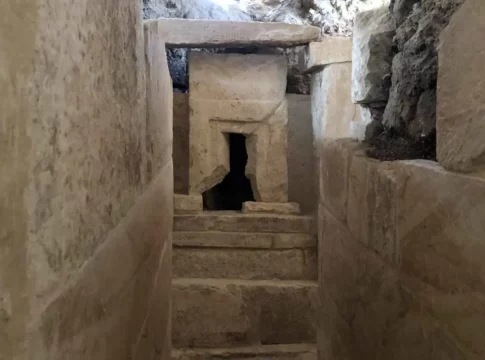
The newly discovered tombs, dating back to the Greek and Roman periods, are adorned with well-preserved hieroglyphic inscriptions. These inscriptions offer rare insights into ancient funerary practices and the religious symbolism of the era. Among the highlights of this excavation season is Tomb No. 38, notable for its exceptional architectural style and preservation. Situated over two meters underground, the tomb is accessed via a nine-step stone staircase flanked by platforms once used for funerary offerings.
Inside, archaeologists discovered a nearly two-meter-tall limestone sarcophagus, featuring a human-shaped lid with distinct facial features and a stylized wig. The intricate decorative elements further enhance its historical value. Two vertical columns of hieroglyphic text on the sarcophagus contain prayers to Aswan’s local deities and identify the tomb’s owner as “Ka-Mesiu,” a high-ranking official. The text also names his family members, and several mummies, including those of children, were found within.
Tourism and Antiquities Minister Sherif Fathy hailed the discovery as a significant addition to Aswan’s rich cultural heritage. He emphasized the importance of international academic collaboration in furthering archaeological research and deepening our understanding of ancient societies.
Dr. Mohamed Ismail Khaled, Secretary-General of the Supreme Council of Antiquities, highlighted the continued use of the cemetery by different social classes as an indication of the area’s long standing funerary significance. He noted that the hieroglyphic inscriptions and burial artifacts provide invaluable material for Egyptologists studying the religious and social customs of later ancient Egyptian periods.
The newly discovered mummies, including those of children, are set to undergo CT scans and biological analysis in the upcoming autumn season. These examinations aim to reveal details about the individuals’ identities, lifestyles, and potential causes of death.
In previous excavation campaigns, the mission uncovered several funerary platforms and rock-hewn tombs in the nearby Sidi Othman mountain area. These tombs, marked by distinctive architectural styles, showcase how ancient communities adapted to the natural landscape in shaping their burial practices.
Led by Dr. Patrizia Piacentini, a professor of Egyptology at the University of Milan, and Egyptian archaeologist Fahmy El-Amin, Director-General of Aswan Antiquities, the mission has been active at the site since 2019. Their successive discoveries continue to affirm the archaeological significance of the Aga Khan Mausoleum area, cementing its status as a key cultural and historical center in southern Egypt.