
A new study from the Massachusetts Institute of Technology’s Media Lab has reignited debate about the hidden costs of relying on artificial intelligence — suggesting that AI tools like ChatGPT may be quietly reshaping the human brain.
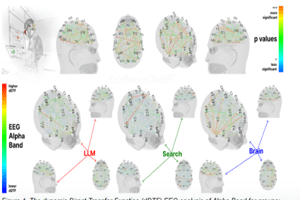
The research, titled “Your Brain on ChatGPT: Accumulation of Cognitive Debt when Using an AI Assistant for Essay Writing Task,” tracked brain activity in 54 volunteers asked to complete essay-writing exercises using different tools: traditional writing, Google search, or ChatGPT.
Participants wearing EEG headsets showed markedly different brain patterns depending on their method. Those who wrote unaided exhibited strong neural connectivity between regions responsible for memory, reasoning, and attention. Google users showed moderate engagement focused on visual processing. But ChatGPT users displayed far weaker brain activity — particularly in the frontal and parietal lobes, areas linked to executive thinking and contextual memory.
When later asked to recall their essays, the AI-assisted group performed worst and described their writing as “not really mine.” The MIT team called this effect “cognitive debt” — the mental equivalent of taking a shortcut today and paying interest tomorrow.
“When people let AI systems do the heavy lifting, their brains exert less effort to structure, reason, and remember,” said lead researcher Pattie Maes. “Over time, that may weaken our ability to think independently.”
Alarmingly, even brief exposure had lingering effects. When former ChatGPT users were asked to write without AI, their neural engagement remained low, as if their brains had adapted to outsourcing effort.
The findings add to growing concerns about automation complacency — a psychological pattern seen in pilots or drivers who overtrust automated systems. Now, it seems, the same tendency may be infiltrating cognitive work.
Neuroscientists warn that the brain’s “use it or lose it” principle still applies in the digital age. “Think of it as a gym for your brain,” explained co-author Eugene Hauptmann. “If you stop lifting mental weights, your cognitive muscles shrink.”
Still, the study doesn’t condemn AI. Used consciously, tools like ChatGPT can serve as partners in thought, helping users refine and test ideas. The risk arises when they replace the act of thinking itself.
The smarter our machines become, the lazier our minds may grow. The question, MIT’s researchers say, is not whether AI will change how we think — it already has — but whether we’ll stay alert enough to keep thinking for ourselves.