
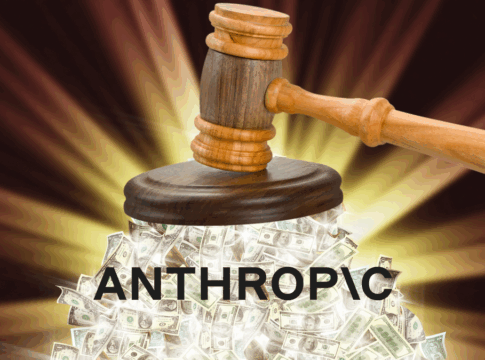
Anthropic, the artificial intelligence firm behind the popular chatbot Claude, is facing a class action lawsuit that experts say could reshape the future of AI development. The case, certified in federal court, accuses the company of training its large language models on millions of pirated books sourced from shadow libraries like LibGen and PiLiMi.
This is the first certified class action lawsuit targeting an AI company for copyright infringement. Federal Judge William Alsup ruled earlier this year that AI models trained on legally obtained works may qualify as “fair use,” but stressed that pirated content is not protected.
Thousands of authors are now eligible to join the lawsuit, with damages ranging from $750 to $150,000 per book. Legal analysts estimate potential payouts could reach $1–3 billion if 100,000 works are covered. In a worst-case scenario—if six million titles are included—Anthropic’s liability could soar past $1 trillion, an existential threat to the company.
“This case could set the standard for how AI firms source data,” said Dr. Rachel Kim, an intellectual property expert at Stanford Law School. “If Anthropic is found liable, companies will have no choice but to rely on licensed datasets, dramatically increasing development costs.”
The lawsuit, scheduled for trial in December 2025, comes as regulators and lawmakers intensify scrutiny of generative AI. Analysts warn that rivals like OpenAI, Meta, and Google could face similar lawsuits if their training practices are challenged.
Beyond the courtroom, the case carries geopolitical weight. U.S. policymakers are divided: some argue strict enforcement is needed to protect authors, while others fear harsh penalties could “cripple” domestic AI firms competing with China.
Meanwhile, the publishing industry—long marginalized by digital piracy—sees the lawsuit as a turning point. “This is about fairness,” said Maria Torres, a spokesperson for the Authors’ Rights Guild. “Writers deserve compensation when their work is used to build trillion-dollar technologies.”
Regardless of the verdict, industry insiders say the lawsuit has already triggered a shift. Many AI labs are racing to create ethically licensed training sets, even at higher costs, to avoid legal fallout. As one analyst put it, “The age of ‘scrape now, apologize later’ may finally be over.”
