
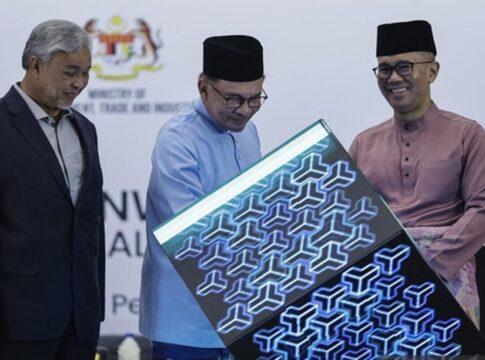
Malaysia has announced an ambitious new chapter in its national development, unveiling a roadmap to become Southeast Asia’s undisputed leader in artificial intelligence (AI) and green technology by the year 2030. Speaking in Parliament during the presentation of the 13th Malaysia Plan (2026–2030), Prime Minister Anwar Ibrahim described the strategy as a “once-in-a-generation opportunity” to shape the future of the region’s digital economy and environmental sustainability. “This plan is about more than growth. It’s about transformation,” Anwar declared. “Malaysia must not just adapt to the global tech race—we must lead it.”
The Strategy: Tech-Driven, Sustainability-Focused
At the core of the plan is an integrated push to scale homegrown innovation in AI, digital infrastructure, and green energy. The blueprint outlines a series of aggressive targets:
- 98% 5G coverage across industrial and rural areas by 2030
- 5,000 new digital entrepreneurs nurtured through government support programs
- Early AI literacy introduced in national education curriculums
- Expansion of “Made by Malaysia” R&D and commercialization programs
- Stronger intellectual property (IP) protections to support tech creators
Malaysia’s strategy aligns with broader regional trends. ASEAN countries have increasingly prioritized digitalization post-COVID, but few have committed to the scale and specificity that Malaysia is now outlining.
Economists see the plan as a timely pivot. As global supply chains reorganize, and as the demand for sustainable technology soars, Malaysia is positioning itself to capture high-value investment in AI, semiconductors, renewables, and smart manufacturing. “If implemented successfully, Malaysia could emerge as the Singapore of AI or the Vietnam of green manufacturing,” said Dr. Lina Wong, a Southeast Asia tech policy analyst at the Asia Digital Futures Institute. “This is not just about economic diversification—this is geopolitical.”
The plan also emphasizes cross-sector collaboration. Government, industry leaders, and academia are expected to co-create AI tools, digital services, and green innovations tailored to local and export markets.
The Ministry of Science, Technology and Innovation (MOSTI) confirmed that several pilot programs are already underway, including AI applications in agriculture and energy efficiency.
In an exclusive to this outlet, MOSTI officials revealed that Malaysia is negotiating a $1.2 billion partnership with two major European AI firms to establish regional research and training centers in Penang and Cyberjaya—details expected to be announced formally in Q4 2025.
To support this technological leap, the government will embed AI education starting from primary school, a move inspired by models in Finland and South Korea. It will also expand funding for universities and tech incubators, while tightening the legal frameworks for data and innovation ownership. “Future readiness starts with future skills,” said Prof. Amirul Rahman, Dean of the Faculty of Computer Science at Universiti Malaya. “The earlier we expose students to AI concepts, the stronger our pipeline of innovators and engineers will be.”
Beyond digital, green technology is expected to be Malaysia’s dual engine of sustainable economic growth. Solar panel manufacturing, electric mobility, and smart grid development will be top priorities, with incentives for green startups and foreign investors already under review.
Malaysia’s central energy transition target—achieving 40% renewable energy in the national grid by 2035—will be directly tied into this tech-forward strategy.
Despite the bold vision, experts caution that execution will be critical. Bureaucratic inertia, regional talent competition, and global tech trade tensions could pose risks.
However, the current momentum suggests Malaysia is aware of these challenges—and is taking steps to mitigate them. “This is Malaysia’s digital moment,” said Tan Sri Dr. Mohd Noor Yusof, former chairman of the National Economic Advisory Council. “We’ve done commodity cycles, we’ve done industrial parks. Now it’s time to lead in brains, bytes, and batteries.”
Malaysia’s vision is clear: to leapfrog into the future not as a follower, but as a leader. Whether that future materializes may depend on whether policy can keep up with promise—and whether innovation can truly be made in, and for, Malaysia.