
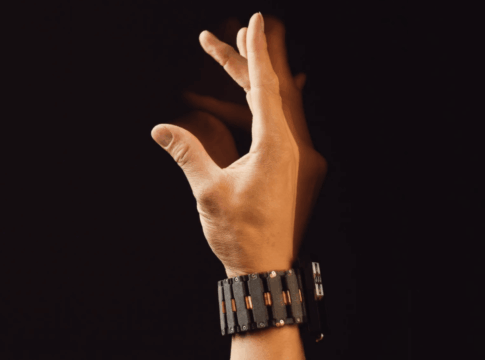
Meta has unveiled a wristband poised to revolutionize how we interact with digital devices. Designed to translate hand gestures into computer commands, this innovative technology could offer significant benefits to individuals with limited mobility while opening new avenues for device interaction.
Published recently in the renowned journal “Nature”, Meta’s Reality Labs team detailed their creation: the sEMG-RD device. This wristband utilizes sensors to convert electrical signals from motor nerves—essentially, instructions from the brain to the hand—into digital commands for connected devices. According to *New Atlas*, these signals enable users to perform tasks such as moving a cursor or converting air-drawn handwriting into text.
Meta’s journey with this technology began years ago, accelerating in 2021 under the leadership of Thomas Reardon. Joining Reality Labs in 2019 as Director of Neural Movement Interfaces, Reardon spearheaded the development of an initial prototype aimed at enhancing augmented reality interactions. The technology’s initial focus was on enabling simple actions like replicating a mouse click. Today, the wristband offers a spectrum of controls, from pinching and thumb movements to handwriting recognition at an impressive 20.9 words per minute.
In an exclusive interview, Dr. Emily Chen, a leading expert in human-computer interaction, commented on the potential of this technology. “Meta’s wristband is not just about convenience,” she said. “It’s about accessibility and breaking barriers for individuals who struggle with traditional input methods.”
The wristband’s technology stands out for its ability to function without individual calibration—a significant leap forward. By utilizing training data from thousands of participants, Meta’s team developed a deep learning system that offers universally accurate interpretations of user inputs. This means users can immediately interact with devices, akin to using a mouse without calibration.
This development follows a trend of similar innovations. In 2023, a system was introduced that used barometric sensors to recognize ten different hand gestures, while the Mudra Band enabled gesture-based control of the Apple Watch through surface nerve conductivity.
Looking ahead, Meta envisions further advancements. The potential to detect intended gesture force could refine controls for cameras and joysticks, reducing the physical effort needed to operate phones and other devices. Most intriguingly, as Dr. Chen suggests, “We may soon be interacting with technology in ways we haven’t even imagined yet.”
As Meta continues to push the boundaries of interaction technology, the implications for accessibility, efficiency, and creativity appear limitless. This wristband might not just replace the mouse and keyboard; it could redefine digital interaction itself.