
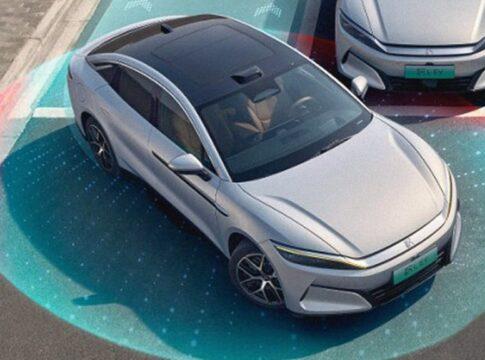
The revelation comes with the latest update to BYD’s advanced “God’s Eye” intelligent driving system, already installed in over a million vehicles across China. Unlike Tesla’s camera-dependent approach, BYD’s system boasts a multi-sensor architecture, including 12 cameras, 5 millimeter-wave radars, and 12 ultrasonic sensors with accuracy to 1 centimeter. This robust setup ensures precision, enabling vehicles to park within 0.8 inches of nearby objects and recognize overhead obstacles.
In addition to the technological prowess, BYD has taken a bold step by offering a financial guarantee covering any damages incurred by the autonomous parking system, underscoring their confidence in the technology. This initiative starkly contrasts with Mercedes-Benz’s more limited L4 parking system, which functions only at Stuttgart Airport under stringent conditions.
Industry experts like Wang Chuanfu, BYD’s Chairman, assert that this advancement will propel the company to achieve full L4 autonomy within the next few years. He notes, “Our approach to combining various sensor technologies provides unmatched accuracy and reliability, setting a new standard in the industry.”
Jim Farley, Ford’s CEO, recently expressed concern about Western automakers falling behind in the face of China’s rapid technological advancements. Speaking at the Aspen Ideas Summit, Farley remarked, “China’s vehicle quality and cost efficiency are far superior to what we see in the West. This is a global competition we cannot afford to lose.”
Tesla, once heralded as a pioneer in electric vehicle innovation, appears to be trailing in the autonomous driving sector. Critics have noted the shortcomings of Tesla’s reliance on camera-only systems, which have led to reliability issues, especially in adverse weather conditions. This has sparked discussions in automotive circles regarding Musk’s dismissal of lidar technology as “a crutch,” a stance that may have hindered Tesla’s progress compared to its competitors.
As BYD continues to expand its technological capabilities, its strides in the autonomous vehicle market highlight the shifting dynamics of global automotive competition. With plans to introduce the “God’s Eye” system to international markets, the company is poised to challenge Western automakers and redefine standards in autonomous driving.
For now, BYD’s achievement in L4 parking is not just a technological feat but a statement of intent, illustrating the profound shift in the automotive industry’s balance of power.