
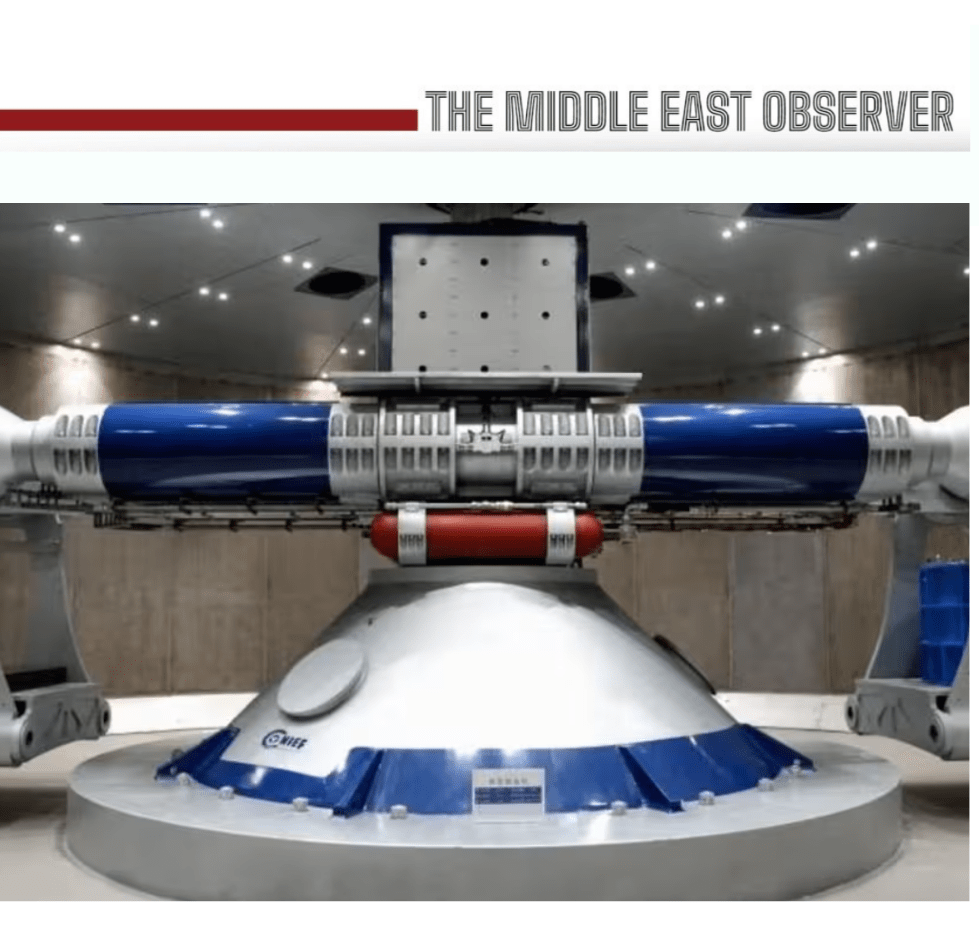
China has unveiled CHIEF1900, now classified as the world’s most powerful centrifuge designed for hypergravity research, marking a significant advance in experimental science and engineering capability.
The system, developed in China, can generate gravitational forces of up to 1,900 times Earth’s gravity, enabling researchers to simulate extreme physical conditions over compressed timeframes. By amplifying gravity, scientists can replicate stresses that would normally take decades, centuries or even millennia to materialise, within controlled laboratory settings.
Researchers say the facility allows large-scale experiments that would otherwise be impractical. For example, scaled models of major infrastructure — such as a 300-metre-high dam — can be tested under gravity levels exceeding 100 times normal force, reproducing real-world structural stress within hours or days.
Beyond civil engineering, CHIEF1900 will be used to examine resonance in high-speed rail systems, assess underground infrastructure stability, and study the long-term migration of pollutants through soil. The platform supports experiments spanning atomic-scale processes to kilometre-scale engineering models, under both standard and extreme temperature and pressure conditions.
The launch follows the start-up of the United States’ CHIEF1300 centrifuge in September, which previously held the global record with gravity levels of up to 1,300 times Earth’s gravity.
The achievement highlights China’s expanding investment in advanced scientific infrastructure and its growing role in frontier research across engineering, environmental science and applied physics.