
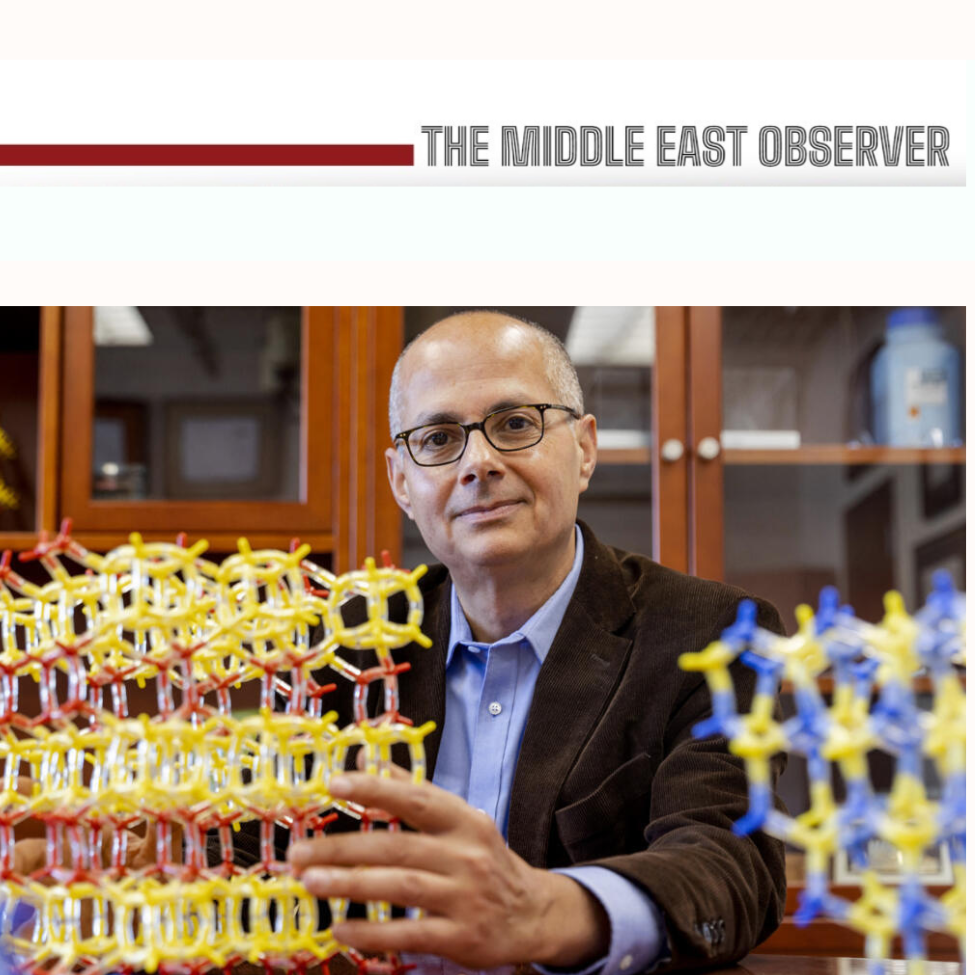
Omar M. Yaghi, a Jordan-born chemist and recent 2025 Nobel Prize laureate in Chemistry, is advancing transformative technology that could provide a sustainable source of freshwater in some of the world’s driest regions by literally making water from thin air.
Yaghi, a professor at the University of California, Berkeley, is globally recognized for his pioneering work in metal-organic frameworks (MOFs) — ultra-porous crystalline materials that act like molecular sponges. MOFs have an exceptionally high internal surface area, allowing them to capture and store gases and vapors, including water molecules from the atmosphere.
In a breakthrough that has attracted international attention, Yaghi and his collaborators have shown that specially designed MOFs can extract moisture from even very dry air, then release that moisture as liquid water when heated by sunlight or low-grade waste heat. The process does not require electricity, making it especially promising for remote and resource-limited areas.
Past field tests of prototype devices based on this technology demonstrated water harvesting in extremely arid conditions, such as Death Valley and the Arizona desert, where the MOF materials absorbed atmospheric moisture at night and released drinkable water during the day’s thermal cycle.
The significance of this work was cited in the Nobel Committee’s 2025 award announcement, which honored Yaghi along with Susumu Kitagawa (Japan) and Richard Robson (Australia) for “molecular constructions with large spaces through which gases and other chemicals can flow,” noting their potential to harvest water from desert air as one key application.
Yaghi’s research has moved beyond the laboratory: his California-based company Atoco is working to commercialize atmospheric water harvesters that could produce hundreds of liters of clean water daily using only ambient sunlight or waste heat, targeting both drought-affected communities and industrial users such as data centers and hydrogen production facilities. Orders for these units are expected to begin in late 2026, underlining the technology’s near-term deployment prospects.
In addition to water harvesting, MOFs developed by Yaghi’s group have broad applications — including carbon dioxide capture and storage, gas separation and storage, and potentially even hydrogen fuel storage — making them a versatile platform in climate mitigation and clean energy technologies.
As water scarcity intensifies worldwide due to population growth, over-extraction of aquifers, and climate change, the ability to draw water directly from the air — even in arid environments — represents a potentially game-changing solution. Yaghi’s work exemplifies how advances in materials science can address fundamental challenges in sustainability and human development.