
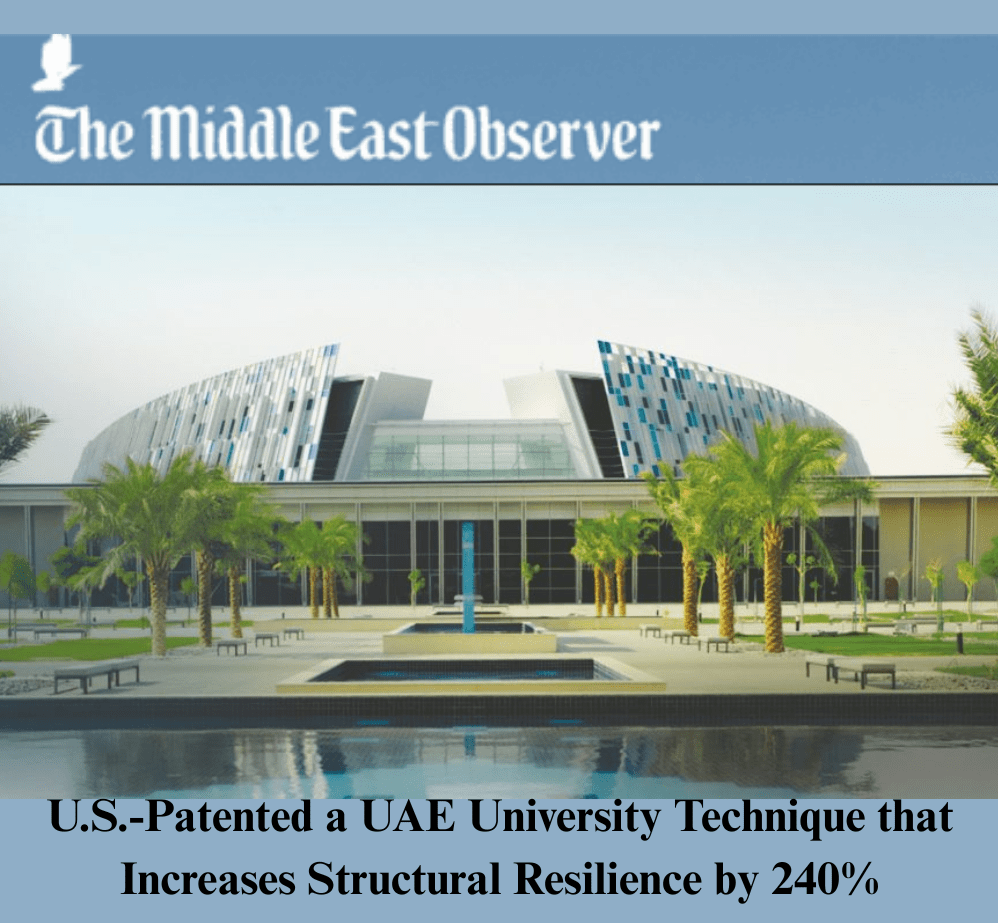
Researchers at United Arab Emirates University (UAEU) have secured a U.S. patent for a breakthrough engineering method designed to strengthen reinforced-concrete buildings and prevent catastrophic collapse. The patent, registered as US 12,116,791, introduces an innovative technique that uses short, diagonal steel bars—often leftover or scrap from construction sites—to create an alternative load path around vulnerable structural columns.
Developed by Professors Bilal El-Ariss and Said Elkholy, along with researcher Ahmad Shehada, the method enhances a building’s ability to withstand sudden column failure, a major cause of progressive collapse in urban structures. Peer-reviewed studies show that the technique can increase a building’s capacity to absorb shock and redistribute forces by as much as 240%, significantly improving overall resilience while keeping costs low.
Engineers emphasize, however, that the patented system is preventive, not corrective. It cannot repair a weakened or unstable building, nor can it “heal” structures already at risk of failing. Instead, the method is intended for use during new construction or as part of a planned reinforcement program in existing reinforced-concrete buildings. Because it relies on standard materials and does not alter typical construction workflows, it can be integrated seamlessly into building projects without added complexity.
The invention has strong sustainability benefits as well, repurposing leftover steel bars that are normally discarded. The UAEU team says the system could be especially where rapid construction and seismic considerations demand stronger, more adaptable structural designs.
With this patent, UAEU has positioned itself at the forefront of structural-safety innovation, offering a practical solution that enhances public safety and aligns with global efforts toward greener, more resilient infrastructure.