
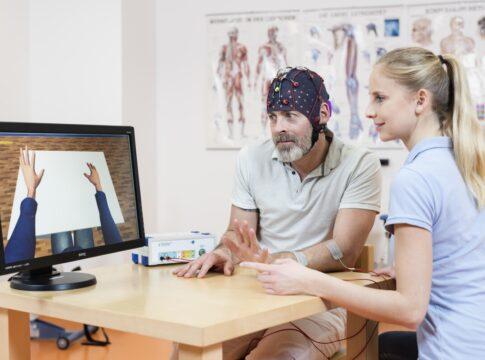
In a new development poised to transform the lives of individuals with paralysis, brain-computer interfaces (BCIs) are on the cusp of moving from experimental labs to commercial reality. This technology, which once seemed like science fiction, is now ready to empower individuals by bridging their thoughts directly to computers and other digital devices.
For over two decades, researchers have explored the possibility of controlling computers through thought alone. Now, companies like Precision Neuroscience, Blackrock Neurotech, Paradromics, and Synchron are leading the charge in making BCIs commercially viable. Notably, Elon Musk’s Neuralink, known for its high-profile developments, faces stiff competition from these seasoned players.
The first wave of BCI users will likely include those affected by spinal injuries or amyotrophic lateral sclerosis (ALS). For these individuals, BCIs offer a revolutionary means of interaction, allowing them to control computer cursors or generate artificial speech. These devices work by detecting and decoding brain signals related to movement or speech, translating thoughts into action through advanced sensors and interfaces.
Michael Mager, CEO of Precision Neuroscience, emphasizes the transformative potential of BCIs: “We know it works, and the enabling technologies are ready. It’s time to turn this academic work into a thriving industry that can make a big impact on people’s lives.”
Neuralink has captured public attention, notably in early 2024, when it successfully implanted a BCI in a man with paralysis at the Barrow Neurological Institute in Phoenix. This involved the delicate task of threading over a thousand electrodes into the brain’s motor cortex, enabling him to interface with digital devices seamlessly.
However, Neuralink’s journey has not been without hurdles. A few weeks after its initial success, the company reported that some electrodes had retracted, reducing the device’s sensitivity. Despite this setback, Neuralink has continued its efforts, reporting BCI implants in at least six other individuals.
BCIs offer the tantalizing prospect of direct mental interaction with technology, as highlighted by Neuralink’s promotional material: “Imagine the joy of connecting with your loved ones, browsing the web, or even playing games using only your thoughts.”
While current BCI technology focuses on basic functions like cursor control, the future holds promise for more advanced features. Dr. Jennifer Collinger, a prominent BCI researcher, notes that while sensory feedback capabilities aren’t yet ready for market, they represent the next frontier in BCI development.
In the past, studies have demonstrated the potential of sensory feedback in prosthetics, enhancing users’ ability to manipulate objects. In a 2021 interview with NPR, participant Nathan Copeland remarked on the enhanced control afforded by touch sensation: “With sensation, I could feel that the hand had made contact. I could also tell if I had a firm grip on it or not.”
As BCI technology continues to evolve, the dream of seamless brain-to-digital communication draws closer, promising profound impacts on accessibility and quality of life for those with severe physical limitations. The journey from lab experiment to commercial product signals a new era where mind and machine converge, offering unprecedented opportunities for human-machine interaction.