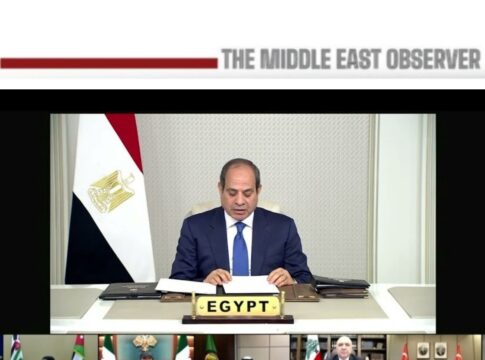
Rising geopolitical tensions in the Middle East have prompted intensified international diplomatic engagement, as global leaders warn that further escalation could threaten both regional stability and the broader global economic system. During an emergency consultation convened by the European Union, President Abdel Fattah El-Sisi joined leaders and senior officials from EU institutions, Gulf Cooperation Council states, and regional partners including Jordan, Lebanon, Syria, Turkey, Iraq, Armenia and Azerbaijan to assess the unfolding crisis and its potential international repercussions.
The virtual summit, attended by European Council President Antonio Costa and European Commission President Ursula von der Leyen, reflected growing concern over the strategic, humanitarian and economic consequences of continued instability in the region. According to Egypt’s presidential spokesman Ambassador Mohamed El-Shenawy, participating leaders stressed the urgent need to halt escalation and intensify diplomatic efforts aimed at achieving a political settlement capable of restoring stability.
Participants strongly condemned attacks targeting Gulf states, Jordan and Iraq, reaffirming the importance of respecting sovereignty and territorial integrity. Discussions also focused on the widening economic and humanitarian implications of the crisis, particularly the risks posed to global energy supplies, maritime navigation routes and international supply chains, which are increasingly vulnerable to regional instability.
In his address, President El-Sisi reiterated Egypt’s long standing diplomatic position advocating de-escalation, dialogue and adherence to international law. He emphasized that the security of Arab states forms an integral part of Egypt’s national security and warned that unresolved regional crises—particularly those related to nuclear proliferation and military confrontation—could trigger a dangerous cycle of escalation capable of destabilizing both the Middle East and the global security architecture.
El-Sisi also highlighted Egypt’s diplomatic efforts to sustain dialogue on the Iranian nuclear file, referring to the Cairo Agreement reached between Iran and the International Atomic Energy Agency in September 2025, which aimed to strengthen confidence-building measures and reduce regional tensions.
A key theme of the discussions was the need to safeguard energy corridors and maritime routes, which remain vital for global markets and international trade. Leaders also addressed the fragile situation in Lebanon, emphasizing support for the Lebanese state’s efforts to consolidate authority and preserve national stability, while underscoring the importance of maintaining Syrian sovereignty amid ongoing regional developments.
Against this backdrop of intensified diplomatic activity, analysts caution that the structural dynamics of regional power politics make escalation particularly dangerous. Since the 1979 Iranian Revolution, the Islamic Republic has developed a deeply entrenched political and security architecture anchored in ideological cohesion and layered institutional structures. Over decades, this framework has cultivated multiple tiers of leadership and loyal security networks, contributing to a system widely regarded as structurally resilient. Unlike many political environments, Iran has not witnessed the emergence of a unified opposition movement capable of presenting an immediate alternative to the governing establishment, making the sudden formation of a viable replacement structure improbable in the near term.
For this reason, many analysts caution that strategies premised on leadership decapitation or abrupt regime destabilisation may not produce the intended outcomes. In strongly ideological systems, the removal of senior figures often results not in institutional collapse but in the rapid emergence of new leadership layers. Such dynamics can fragment decision-making structures, potentially hardening positions within the state apparatus rather than moderating them.
Regional tensions surrounding Iran’s nuclear programme have remained a central geopolitical concern for more than a decade. Since 2012, Israeli Prime Minister Benjamin Netanyahu has consistently warned that Iran poses a serious strategic challenge, urging stronger international action to prevent Tehran from advancing its nuclear capabilities. These concerns contributed to sustained pressure on the United States and its allies to adopt a firmer posture toward Iran, manifested primarily through successive rounds of economic sanctions, diplomatic isolation and, at times, covert or targeted actions against elements of Iran’s nuclear infrastructure.
While previous diplomatic frameworks and negotiations produced intermittent progress, they ultimately struggled to deliver a durable resolution. Nevertheless, diplomacy remained widely viewed by many international actors as the most viable path toward managing the dispute and preventing further escalation. In a significant and controversial development, however, tensions sharply intensified when the United States and Israel launched direct military operations against Iranian targets, marking a dramatic shift from containment and negotiation toward open confrontation.
The direct military confrontation that unfolded carried significant strategic implications for the Middle East. One immediate concern centered on U.S. military installations across Gulf states, which host American forces and function as major operational hubs. As hostilities escalated, these facilities—along with surrounding logistical networks and energy infrastructure—were widely viewed as potential targets of retaliation, placing host countries in a delicate strategic position despite not being primary parties to the conflict.
Beyond the military dimension, the economic repercussions quickly became evident. The escalation heightened volatility in energy markets, disrupted segments of global supply chains and raised concerns over the security of key maritime trade corridors. These developments added further pressure to an already fragile global economic environment, intensifying inflationary risks and uncertainty at a time when many economies were still navigating the lingering effects of recent geopolitical and economic shocks.
Strategists increasingly warn that confrontation between Iran and its adversaries could quickly evolve from a bilateral crisis into a broader regional conflict involving multiple actors and theatres. In this context, the measured restraint demonstrated by Gulf leadership in the face of mounting tensions has played an important role in preventing further destabilisation and maintaining a defensive posture that prioritises regional stability.
For this reason, many policymakers stress that diplomatic containment and de-escalation remain the most viable path to preventing a wider crisis. Once a conflict of this magnitude fully unfolds, the ability of any single actor to manage or contain its trajectory becomes significantly diminished.
As tensions continue to rise, the fundamental question facing the international community is whether political dialogue and diplomatic engagement can still prevail over military escalation—before the situation reaches a point at which it becomes too complex to control.