
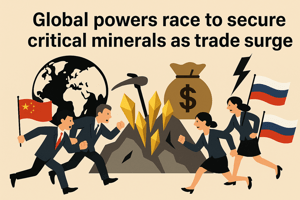
The United States is racing to build a strategic buffer of critical minerals, just as China tightens export controls and markets brace for President Donald Trump’s threat of 100% tariffs on Chinese imports.
Recent filings show the Pentagon’s Defense Logistics Agency (DLA) plans to buy up to $1 billion in key materials — including $500 million of cobalt, $245 million of antimony, $100 million of tantalum, and $45 million of scandium — expanding a stockpile valued at $1.3 billion in 2023. The purchases aim to blunt Beijing’s grip on supply chains for defense systems, semiconductors, EVs, and grid technology.
China’s Ministry of Commerce recently unveiled its strictest export controls yet on rare earths and magnet technologies, sending September exports sharply lower and reinforcing its position as the world’s dominant rare-earth processor. Trump’s tariff threat, due November 1, is meant to pressure Beijing into easing restrictions, signal industrial resolve at home, and deter further “weaponization” of minerals. China has vowed retaliation, calling its measures legitimate export management.
While the Pentagon expands its depot network, analysts warn the strategy faces execution risks — from contract delays and supplier concentration to the absence of antimony refining capacity outside China. Even with a $1 billion buffer, true resilience will depend on new processing routes and allied partnerships, such as DoD collaborations with MP Materials, to rebuild “mine-to-magnet” supply chains.
Meanwhile, Russia, leveraging its dominance in palladium and nickel through Nornickel, has extended export restrictions and bans on precious-metal scrap to boost domestic refining and preserve strategic leverage in a sanctions-laden market. Yet, despite this strength, the sector remains constrained by limited financing and technology access, slowing the modernization and expansion targeted under Moscow’s industrial strategy.
The cumulative effect is a volatile new equilibrium. Every licensing tweak in Beijing now jolts prices of EV metals and defense-grade alloys, with traders treating rare-earth bulletins like monetary policy statements. Analysts note the global minerals market has become the new arena of economic statecraft — where the U.S. buys time, China codifies chokepoints, and Russia preserves leverage.
In the emerging minerals race, stockpiles, controls, and volatility are set to grow long before the world builds enough independent refining capacity to balance the scales.