
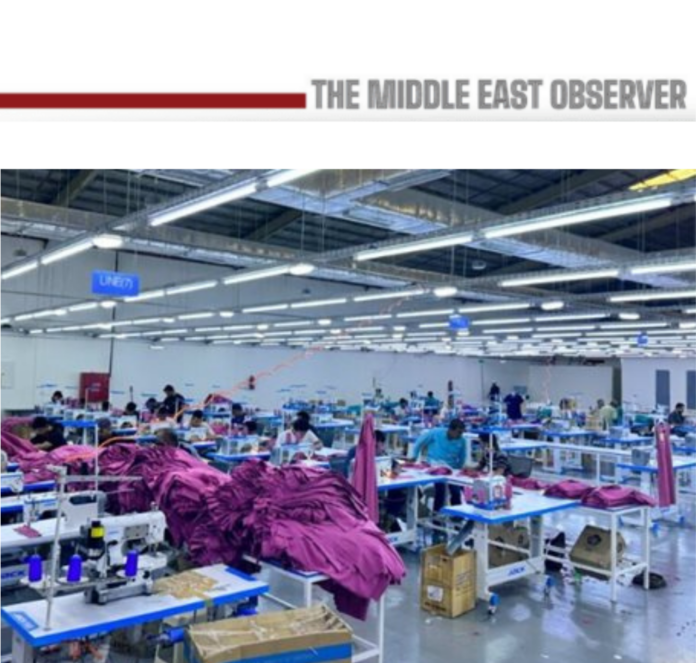
Egypt has approved a US$15 million investment by Karnak Textile for Ready-Made Garments to establish a new export-oriented factory in Sadat City’s CPC Industrial Complex, underscoring Cairo’s strategy of expanding labour-intensive manufacturing as global apparel supply chains continue to diversify beyond traditional Asian production centres.
Approved under Egypt’s private free zone regime, the project reflects the government’s wider industrial policy of attracting export-led investment capable of generating foreign currency revenues, deepening local manufacturing and creating skilled employment. The factory, scheduled to begin commercial operations in May 2027, is expected to create around 3,500 direct jobs, source at least 50% of its production inputs locally, and export its entire output to the European Union and the United States.
Located on a 31,535-square-metre site in Monufia Governorate, the facility will operate under Egypt’s private free zone framework, which enables export-oriented manufacturers to complete customs procedures on-site and benefit from streamlined import and export processes. The regime has become an increasingly important policy tool for improving logistics efficiency and reducing administrative costs for internationally focused manufacturers.
The investment comes at a time when Egypt is seeking to transform its textile and ready-made garments industry into one of the country’s principal manufacturing export engines. The government has outlined plans to raise annual textile and garment exports to around US$12 billion by 2031, supported by large-scale modernisation of state-owned spinning and weaving facilities, expanded industrial zones, and policies aimed at increasing domestic value addition across the cotton-to-garment supply chain.
Recent trade performance suggests that the sector is gathering momentum. According to the Apparel Export Council of Egypt, ready-made garment exports rose 15% year-on-year to US$1.15 billion during the first four months of 2026, while April alone recorded a 33% annual increase. Industry leaders expect exports to approach US$4.4 billion this year, representing the highest annual level on record for Egypt’s garment industry.
Industry executives attribute the stronger performance to a combination of rising international demand, improvements in manufacturing quality and delivery reliability, and sustained investment in production capacity. The emphasis on higher local sourcing is also expected to strengthen Egypt’s upstream textile industry, reduce dependence on imported intermediate inputs and improve the sector’s overall competitiveness in international markets.
The Karnak project also reflects wider shifts reshaping global manufacturing. Escalating labour costs in parts of East Asia, continued efforts by multinational brands to diversify supply chains following the pandemic, and geopolitical disruptions affecting international logistics have encouraged manufacturers to establish production closer to European consumer markets. Egypt is increasingly positioning itself alongside manufacturing competitors including Turkey, Morocco, Bangladesh and Vietnam, while leveraging preferential access to the European Union, the Qualifying Industrial Zones (QIZ) programme for duty-free exports to the United States, the African Continental Free Trade Area (AfCFTA), COMESA and Arab regional trade agreements to strengthen its competitive position.
Foreign investors have responded accordingly. Turkish, Chinese and Gulf manufacturers have announced a series of textile and apparel investments across Egypt over the past two years, attracted by competitive labour costs, expanding industrial infrastructure and improving connectivity through industrial zones and logistics corridors. These investments complement the government’s broader ambition of developing integrated textile clusters spanning cotton cultivation, spinning, weaving, fabric production and finished garments.
For policymakers, the significance of the Karnak investment extends well beyond the construction of a single factory. It represents another step in Egypt’s effort to reposition manufacturing as a major source of export earnings at a time when the country is seeking to narrow its trade deficit, attract higher levels of productive foreign direct investment and create sustainable employment. If current investment and export trends continue, the textile and garment industry is likely to play an increasingly central role in Egypt’s industrial transformation and its ambition to establish itself as one of the Mediterranean region’s leading export manufacturing platforms.
Related news:
Zhejiang Hongda Textile Manufacturing Invests $20m in Egypt’s Growing Textile Export Hub
Paradise Textiles to Invest $102m in Egypt
Read also:
Saudi Arabia Grants ACWA Power Exclusive Green Hydrogen Export Mandate