
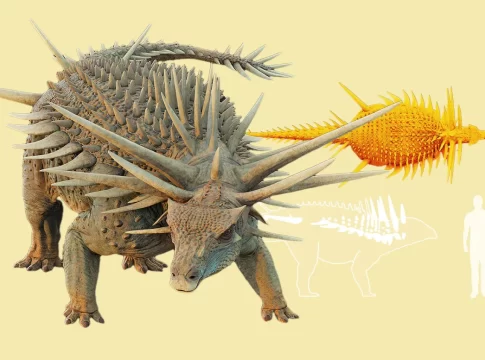
Deep in Morocco’s Atlas Mountains, paleontologists have uncovered one of the most extraordinary dinosaur fossils yet: Spicomellus afer, a 165-million-year-old ankylosaur armored with lethal spikes—even sporting a primitive tail weapon.
The newly unearthed remains, including rib fragments, vertebrae, a spiked neck collar, and fused tail bones, reveal that this ankylosaur boasted bone spikes fused directly to its ribs—an anatomical oddity unrecorded in any other vertebrate. Measuring about 4 meters (13 ft) and weighing up to two tonnes, Spicomellus rivals the most bizarre creatures of the Jurassic.
Scientists believe the neck collar, with spikes up to 87 cm long, served dual purposes—dramatic display as well as defense. Co‑leader Prof. Susannah Maidment of the Natural History Museum called it “completely unlike any animal living or dead,” pushing landmarks in both fossil architecture and evolutionary biology.
The discovery also resets the timeline: the fused vertebrae in the tail suggest that ankylosaur tail weapons originated 30 million years earlier than previously believed.
Exclusive insight: MRI-style CT scans being conducted at the University of Birmingham are revealing hidden structural details of the spiked collar, hinting that its spikes may have been hollow or air-filled—potentially making them lighter and more functional in mating displays, a feature rarely speculated in dinosaur armor studies.
The find challenges long-held assumptions about early ankylosaurs, typically considered moderately armored. Instead, Spicomellus suggests that dramatic, expressive defenses were evolving much earlier in the group’s lineage.
But the story comes with a sobering side: fossil poaching remains an urgent issue. Partial remains of Spicomellus have surfaced on black markets, underscoring the need for strengthened protections in Morocco’s fossil-rich regions.
As Dr. Richard Butler from the University of Birmingham notes, Spicomellus afer isn’t just a fossil—it’s a “jaw-droppingly weird” window into the dynamics of dinosaur evolution and the surprising paths life can take.