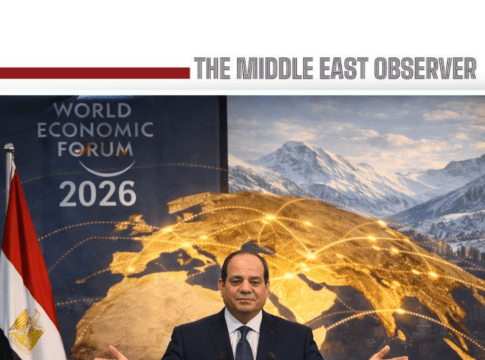
The World Economic Forum (WEF) Annual Meeting, held each January in Davos-Klosters, Switzerland, is one of the world’s most influential gatherings of political leaders, global executives, investors, and policymakers. The 2026 edition, which ran from 19 to 23 January, convened nearly 3,000 participants from more than 130 countries, providing a platform for strategic dialogue at a time of heightened geopolitical tension and economic fragmentation.
Against this backdrop, Abdel Fattah El-Sisi used Egypt’s highest-level participation to deliver a focused message to international investors: Egypt is positioning itself as a regional investment platform anchored in private-sector growth, large-scale infrastructure, and sustained macroeconomic reform, even as it navigates a complex regional and global environment.
During the second half of the forum, President El-Sisi took part in a closed-door dialogue session with international business leaders, attended by around 70 chief executives and heads of major global and regional financial and investment institutions. The session was moderated by WEF Interim Co-Chair of the Board of Trustees André Hoffmann and WEF Managing Director Maroun Kairouz, and brought together leaders from energy, transport, infrastructure, digital transformation, and financial services.
Opening the discussion, Hoffmann highlighted Egypt’s standing at Davos, noting growing international interest in its economic trajectory and reform agenda. President El-Sisi, in turn, underscored the state’s commitment to deepening private-sector participation, describing it as the cornerstone of Egypt’s strategy for comprehensive and sustainable development.
The President outlined the government’s reform programme, emphasising measures aimed at rebalancing the relationship between the state and the private sector. These include capping public investment, implementing the State Ownership Policy Document, and advancing the government’s IPO programme, which has already increased the private sector’s share of total investment. He also pointed to targeted incentives in priority sectors such as electric vehicle manufacturing, information technology, pharmaceuticals, renewable energy and green hydrogen, supported by the Green Hydrogen Incentives Law, the Golden License scheme, and streamlined procedures through a unified digital platform.
Infrastructure featured prominently in Egypt’s investment pitch. El-Sisi cited major upgrades to road, rail and transport networks, improvements in port efficiency, and the continued expansion of the Suez Canal Economic Zone (SCZONE). He also referenced ongoing Suez Canal development projects, reinforcing its role as a critical artery for global trade, particularly as shipping activity gradually recovers following regional de-escalation efforts.
The President further emphasised Egypt’s push for digital transformation and industrial localisation, anchored by investments in digital infrastructure and the rollout of Egypt’s Industrial Strategy 2030, aimed at increasing the industrial sector’s contribution to GDP. He pointed to the positive outcomes of Egypt’s economic programme implemented with international financial institutions, notably the International Monetary Fund, citing improvements in macroeconomic indicators, foreign-currency reserves, growth rates, and debt sustainability.
Discussions with business leaders extended beyond reform frameworks to sector-specific opportunities. Participants examined the strong rebound in Egypt’s tourism sector, the expanding role of the private sector in national projects, and opportunities within the SCZONE to attract foreign investment. Healthcare also featured prominently, with El-Sisi outlining efforts to modernise infrastructure, expand services under Universal Health Coverage, and adopt advanced medical technologies, while stressing the importance of private-sector investment in strengthening the system.
Beyond the business agenda, Egypt’s Davos engagement included high-level geopolitical diplomacy. On the sidelines of the forum, President El-Sisi held strategic discussions with Donald Trump, against the backdrop of developments in Gaza and renewed U.S. signals of willingness to facilitate mediation on the Grand Ethiopian Renaissance Dam (GERD) dispute. Public reporting confirmed that these engagements were diplomatic and strategic in nature, with no bilateral commercial agreements signed during the Davos meetings.
Concrete outcomes nonetheless emerged during Davos week. Egypt announced an MoU between GIZ Egypt and IFAD under the NWFE platform to support climate-resilient agriculture, signed $170 million in development policy financing from the African Development Bank alongside a $0.4 million grant to support sustainability at the Abu Rawash Wastewater Treatment Plant, and agreed to extend its OECD Country Programme to June 2026 to complete reform and competitiveness workstreams.
In meetings with multilateral partners, Egyptian officials highlighted $4.5 billion mobilised for NWFE energy projects, with 5.2 GW already implemented and 8.25 GW of signed power-purchase agreements toward a 10 GW target, alongside cooperation on industrial decarbonisation. Engagements with the World Bank Group reinforced a shift toward private-sector-enabled growth and real-economy transformation.
Egypt’s reform narrative was capped by remarks from Finance Minister Ahmed Kouchouk, who told Davos participants that private investment grew by 73% last year, a headline used to underline reform momentum and bolster investor confidence.
In sum, Egypt’s Davos presence projected confidence grounded in substance. By combining reform momentum, institutional stability, and active geopolitical engagement, Cairo positioned itself as a secure and credible destination for long-term investment, underpinned by infrastructure depth, improving macroeconomic fundamentals, and strong multilateral partnerships. While major bilateral transactions remain under development, the signal to global capital was clear: Egypt is open for business, committed to policy continuity, and offering investors opportunity matched by scale, resilience, and stability.