
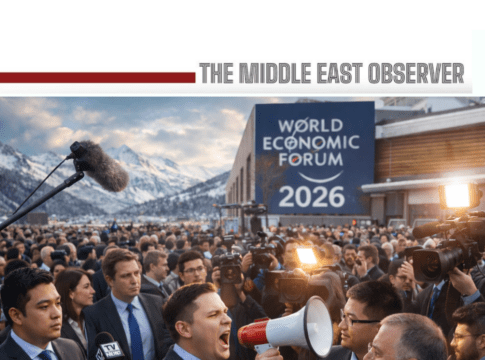
The 56th World Economic Forum Annual Meeting in Davos-Klosters (19–23 January) convened nearly 3,000 leaders from more than 130 countries, including around 65 heads of state and over 830 CEOs and technology pioneers, making it one of the most geopolitically charged editions in recent years. The agenda reflected a world grappling with fragmented governance, accelerating technological change, and the growing trade-off between security imperatives and economic growth.
Transatlantic tensions and the Greenland reset
At the top of the agenda, U.S.–Europe relations were tested by tensions over Greenland and Arctic security. President Donald Trump initially threatened tariffs on several European countries to press support for U.S. strategic objectives in the Arctic. The dispute was subsequently de-escalated through high-level talks with NATO leadership, producing a framework for future cooperation on Arctic security, infrastructure, and coordination.
Crucially, the understanding reaffirmed Greenland’s sovereignty under the Kingdom of Denmark, while committing both sides to closer transatlantic collaboration in the Arctic. While the episode ended without escalation, it underscored structural strains in the U.S.–EU relationship, reinforcing Europe’s push for greater strategic autonomy even as leaders signalled willingness to engage pragmatically with Washington where interests converge.
The “Board of Peace”: ambition meets resistance
Davos also marked the international launch of the U.S.-initiated “Board of Peace”, framed as a new conflict-resolution mechanism with an initial focus on rebuilding Gaza and broader ambitions for global mediation.
Around 35 countries agreed to participate, led largely by Middle Eastern and emerging-market states, while traditional U.S. allies in Europe and Canada showed clear reluctance. Spain, France, Germany, Sweden and Norway publicly declined to join, citing concerns over governance, compatibility with the UN system, and legal mandate. Slovenia warned the initiative could undermine the international order, while Canada’s invitation was later withdrawn by Washington.
Under a draft framework, countries seeking a permanent seat—expected to be held by Trump for life—would need to contribute at least $1 billion, with other members serving three-year terms. The mixed response highlighted a broader Davos theme: the erosion of consensus around new diplomatic architectures, and growing tension between U.S.-led ad-hoc initiatives and UN-centred multilateralism.
AI moves from hype to hard constraints
Artificial intelligence dominated Davos discussions, rivaling geopolitics and trade as the defining issue of the forum. Leaders broadly agreed that AI capabilities are advancing faster than governance, infrastructure, and social adaptation.
Tech executives painted sharply contrasting futures. Elon Musk warned that AI could surpass human intelligence as early as 2026, predicting rapid advances in humanoid robotics and material abundance, while cautioning that energy generation—not chips—will become the main bottleneck. Nvidia’s Jensen Huang framed AI as a once-in-a-generation opportunity, particularly for regions able to fuse manufacturing strength with AI infrastructure, and argued that AI will boost demand for skilled trades rather than eliminate work.
Others stressed deployment over hype. Microsoft’s Satya Nadella argued AI must deliver tangible outcomes for societies and industries, warning that adoption will be uneven due to constraints in capital, power grids, and digital infrastructure, areas still largely shaped by government policy. This pragmatic view was reinforced by sovereign investors, particularly from the Gulf, who emphasised AI infrastructure and robotics as pillars of future industrial competitiveness.
Risks, labour, and governance
Alongside optimism, Davos featured stark warnings. AI pioneer Yoshua Bengio cautioned against designing systems that mimic human behaviour too closely, warning of misplaced trust and social distortion. Philosopher Yuval Noah Harari argued that super-intelligent systems could also be deeply flawed, calling for humility and built-in correction mechanisms.
From a geopolitical angle, Anthropic CEO Dario Amodei warned that unchecked AI diffusion—particularly advanced chip exports—could undermine safety and global stability, while reiterating concerns that AI could eliminate a significant share of entry-level white-collar jobs. Google DeepMind CEO Demis Hassabis struck a more optimistic note, expecting new and more meaningful roles to emerge, while acknowledging that post-AGI labour markets remain uncharted territory and require minimum global safety standards.
A Davos defined by acceleration, not consensus
Davos 2026 marked a turning point. The debate shifted decisively from AI capability races to implementation, infrastructure, and societal impact, while geopolitics moved from alliance management to transactional, issue-by-issue cooperation. The forum did not deliver sweeping agreements, but it clarified the direction of travel: technology is outpacing institutions, geopolitics is fragmenting governance, and capital is moving faster than consensus.
In this environment, Davos revealed a world entering an era of selective cooperation, where success depends less on universal alignment and more on credibility, speed, and the ability to operate amid fragmentation.