
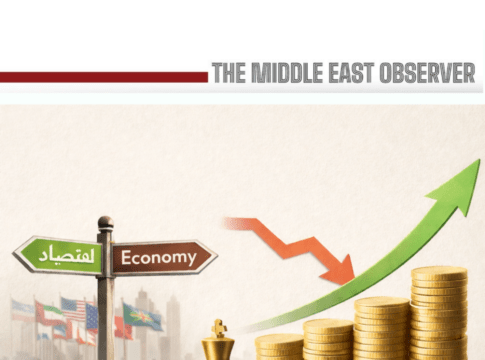
As of January 2026, global geopolitics can no longer be understood without placing economics at its core. The international system did not fracture overnight; rather, 2025 marked the year when political alignments, military doctrines, and economic resilience began moving in the same direction—away from institutional comfort and toward power-weighted pragmatism. What 2026 now reveals is not merely diplomatic realignment, but the financial and economic price of delay, dependency, and unresolved conflict.
The defining shift of 2025 was the normalization of uncertainty as a planning assumption. Governments, investors, and defense establishments alike began to treat geopolitical volatility as a permanent macroeconomic condition, not a cyclical shock. Defense budgets rose, trade diversification accelerated, sanctions regimes hardened, and capital increasingly priced in political unpredictability. This shift had immediate consequences: higher borrowing costs for vulnerable states, disrupted supply chains, elevated energy premiums, and a renewed focus on geography, resources, and strategic choke points. By the end of 2025, it was clear that the post-Cold War separation between economic globalization and political stability no longer held.
NATO remains intact in early 2026, but its internal imbalance is now as much economic as military. European states dramatically increased defense spending following Russia’s war in Ukraine, yet this surge has collided with fiscal constraints, aging populations, and post-pandemic debt burdens. Europe’s delayed pursuit of strategic autonomy, first articulated in the 1960s by Charles de Gaulle and more recently revived by Emmanuel Macron, carries a clear economic cost. Fragmented defense procurement inflates expenses, while reliance on US systems drains capital outward rather than building domestic industrial capacity. Energy insecurity—exposed in 2022–2023 and only partially resolved—continues to limit Europe’s strategic flexibility. As a result, Europe enters 2026 more militarized, yet not more independent, paying a premium for late adaptation.
The United States’ posture entering 2026 reflects a shift from alliance management to economic statecraft. Under the renewed influence of Donald Trump, Washington emphasizes tariffs, sanctions, market access, and control of strategic geography as tools equal to military power. This approach is fiscally efficient but politically destabilizing. By leveraging its role in global finance, energy markets, and defense supply chains, the US reinforces dominance without large troop deployments. However, allies increasingly price in US policy volatility, diversifying reserves, trade routes, and defense suppliers where possible. The short-term economic gain for Washington is clear; the long-term cost may be accelerated de-dollarization and reduced alliance cohesion.
Russia enters 2026 operating a fully adapted war economy. Sanctions have not collapsed the state, but they have reshaped it. Moscow has redirected trade toward Asia, expanded energy discounts, and deepened state control over key sectors. Growth is uneven and inflationary, yet the Kremlin prioritizes endurance over efficiency. Politically, Russia benefits from a world less committed to old rules enforcement and shown little hesitation in sidelining even its own partners, prioritizing direct outcomes over alliance discipline. Economically, however, prolonged militarization limits long-term innovation and consumer welfare. Russia’s diplomacy in 2026 is therefore defensive: consolidate territorial and strategic gains while preventing economic exhaustion. Defeat for Moscow is not military collapse, but structural stagnation.
China approaches 2026 with a clear objective: preserve economic stability while navigating geopolitical friction. Beijing’s official statements emphasize predictability, opposition to sanctions, and continuity in global trade—positions that align with a US shift away from ideological confrontation toward transactional engagement. China benefits from a fragmented West and a weaker multilateral system, yet remains vulnerable to trade disruptions, capital flight, and demographic pressure. Its alignment with Washington’s pragmatism is tactical, not ideological. Diplomacy for Beijing is an economic necessity; defeat would manifest not as conflict, but as growth deceleration and internal strain.
Iran faces the most acute convergence of political and economic pressure. Prolonged sanctions have eroded purchasing power, constrained energy revenues, and driven sustained inflation that is increasingly paralyzing the domestic economy. By 2026, rising prices, currency depreciation, and declining household resilience have intensified social strain, sharply narrowing the leadership’s room for maneuver. In this context, Tehran frames negotiations not as concession, but as resistance under constraint. Diplomacy offers a pathway to limited economic normalization and inflation relief; refusal risks locking the country into deepening stagnation and internal exhaustion. However, Iranian strategic doctrine makes clear that if confrontation turns existential, the regime is prepared to escalate fully—fighting not for leverage, but for survival. In such a scenario, restraint would give way to endurance, regional escalation, and asymmetric disruption, with Tehran willing to absorb severe costs and project instability across the region rather than accept collapse. For Iran, diplomacy is not about winning; it is about preventing a final confrontation in which the state would commit to fighting until survival is secured or the system itself gives way.
If 2025 was the year the geopolitical order visibly shifted, 2026 is the year its economic consequences become unavoidable. Power politics have returned, but they now operate through budgets, markets, supply chains, and energy flows as much as through armies. Alliances still exist, yet they are increasingly measured in cost-benefit terms rather than shared destiny.
History is unlikely to record 2026 as a year of collapse. Instead, it will be remembered as the moment when states fully accepted that economic resilience—not ideology, not institutions—had become the primary currency of survival. From this point forward, diplomacy is no longer about preserving a fading order, but about minimizing loss in a world where delay itself has become the most expensive mistake.