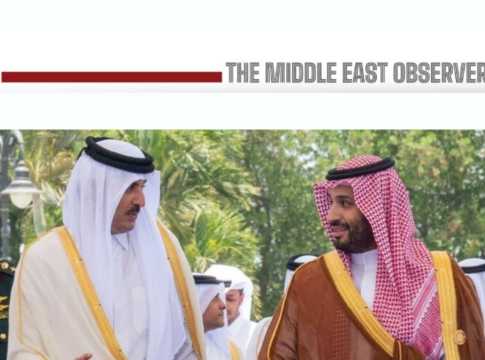
Saudi Arabia and Qatar took a significant step toward deeper Gulf integration on Monday as Saudi Crown Prince Mohammed bin Salman and Qatari Emir Sheikh Tamim bin Hamad Al Thani jointly chaired the eighth meeting of the Saudi-Qatari Coordination Council in Riyadh. The summit produced a broad package of agreements spanning energy, transport, defence, investment, and the digital economy, underscoring the rapid normalisation and expansion of ties between the two neighbours.
At the centre of the announcements was a flagship agreement to develop a 785-kilometre high-speed electric railway linking Riyadh and Doha. The proposed line is designed to cut travel time between the two capitals to around two hours, connecting both countries’ international airports via Dammam and Hofuf. Officials said the railway is expected to carry up to 10 million passengers annually and generate around 30,000 jobs, positioning it as one of the most ambitious cross-border infrastructure projects in the Gulf.
Both governments described the rail project as a strategic investment aligned with Saudi Arabia’s Vision 2030 and Qatar National Vision 2030, aimed at boosting economic diversification, mobility, and regional connectivity. Beyond transport, the agreements reached at the council meeting extend cooperation into areas including renewable energy, industrial integration, climate policy, mining, culture, media production, education, youth programmes, and cybersecurity, as well as enhanced coordination on defence and intelligence.
The summit followed several days of intensive diplomatic engagement, including preparatory talks between the two countries’ foreign ministers in Riyadh. It highlighted the extent to which relations have evolved since the 2021 Al-Ula GCC summit, which ended the Saudi-led land, sea, and air blockade of Qatar. Since the restoration of ties, economic relations have expanded sharply, with bilateral trade reaching $930.3 million in 2024, representing a 634 percent increase compared with 2021.
The breadth of the new agreements reflects a wider political convergence between Riyadh and Doha. Once divided by one of the deepest rifts in the Gulf Cooperation Council’s history, the two countries now increasingly coordinate on regional issues, including Syria’s transitional process and diplomatic efforts linked to the Gaza conflict.
The planned Riyadh-Doha railway also revives momentum behind the long-discussed Gulf Railway Project, transforming a previously stalled vision into tangible infrastructure. If completed, the line would strengthen trade flows, labour mobility, and supply-chain integration across the Arabian Peninsula, serving as a physical symbol of renewed GCC connectivity.
The initiative comes amid a broader acceleration of rail development across the Gulf. Construction on the Oman-UAE rail link began in 2024, while Saudi Arabia continues to expand its domestic network, aiming to more than double rail coverage beyond its current 5,500 kilometres. Major projects such as the Riyadh Metro and the Haramain High-Speed Railway illustrate the kingdom’s push to overcome financing and execution challenges as it scales up transport infrastructure to support long-term economic transformation.