
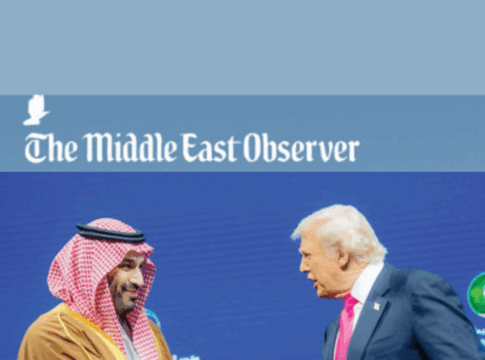
Saudi Arabia’s Crown Prince Mohammed bin Salman concluded a historic visit to the United States, last week, that yielded one of the most extensive economic and strategic packages ever announced between the two countries, reaffirming Washington and Riyadh’s intention to anchor their long-term partnership in a mix of technology, energy, defence and financial cooperation.
According to the Saudi Ministry of Investment, the cumulative value of agreements and commercial commitments now totals US$575 billion, consolidating US$307 billion signed during President Donald J. Trump’s visit to Riyadh in May 2025 and US$267 billion in new deals unveiled in Washington during the Crown Prince’s visit. The scale and breadth of the portfolio place it among the most comprehensive bilateral investment frameworks ever executed between the US and a Middle Eastern state.
The agreements span sectors that increasingly define global competition. In energy and petrochemicals, Saudi Aramco concluded 83 agreements worth US$143.6 billion with American partners including Halliburton, Baker Hughes, SLB, KBR and Fluor, covering LNG infrastructure, advanced refining technologies and industrial services. Technology and artificial intelligence formed another core pillar, with 66 agreements worth US$57.7 billion, including a significant memorandum of understanding between the Public Investment Fund, the Saudi Information Technology Company and Microsoft to develop sovereign cloud capabilities inside the Kingdom. Further deals with leading US firms in semiconductors, hyperscale computing and data-centre infrastructure reinforce Riyadh’s ambition to position itself as a global AI hub.
The defence and aerospace sector contributed US$133 billion, highlighted by cooperation under a new Strategic Defense Agreement intended to formalise long-term security alignment and facilitate advanced US platform access. Among the commercial components, Saudia Technic and GE Aerospace concluded a programme to deploy and maintain GEnx-1B engines for 39 Boeing 787 aircraft, paired with commitments to expand localised aviation-maintenance capability. In finance and investment, eight initiatives totalling US$18.7 billion included a SAR 12 billion arrangement between the National Development Fund and Northern Trust for global asset-management and custodian services, and American institutional participation in the Jafurah gas-processing infrastructure led by GIP/BlackRock. Further commitments in infrastructure, entertainment, gaming, healthcare and education collectively added more than US$66 billion, involving US companies such as JLL, Silverstein Properties, Cleveland Clinic, Mass General Brigham and UCLA Health.
Global media coverage reflected a wide spectrum of reaction. Outlets such as Reuters, CNBC, Bloomberg and the Financial Times described the announcements as a decisive reset in US–Saudi relations, with analysts highlighting Saudi Arabia’s emergence as a major force in global AI, advanced manufacturing and energy markets. Others, including the Washington Post, Politico and The Guardian, raised concerns regarding the geopolitical implications of closer defence and nuclear cooperation, as well as questions about the long-term execution and transparency of headline investment figures.
Yet the timing and structure of the agreements point to a deeper strategic calculus. The US, facing accelerating competition in artificial intelligence, critical minerals and energy systems, has quietly sought capital-rich partners capable of supporting industrial projects of continental scale. Saudi Arabia, meanwhile, is shifting from a model of technology importation to one that seeks joint ownership of strategic industries. The alignment therefore reflects more than a transactional revival. It marks a structural repositioning between two states preparing for a global order defined by AI capacity, energy security and industrial resilience. For Washington and Riyadh alike, the US$575 billion portfolio is both an economic milestone and a geopolitical statement: that the future of their partnership will be shaped not only by defence ties, but by co-investment in the technologies and systems that will define the next generation of global power.