
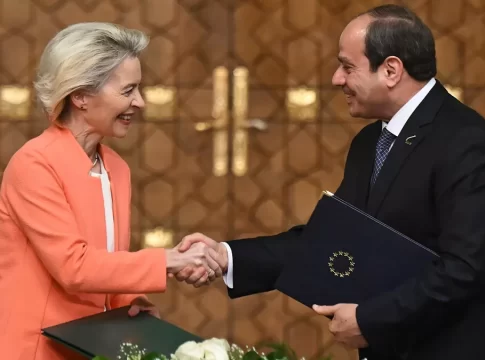
The inaugural Egypt–EU Summit in Brussels on 22 October 2025 marked a defining shift in Cairo’s relations with Europe — from transactional diplomacy to a strategic production and energy alliance.
President Abdel-Fattah El-Sisi and European Commission President Ursula Von Der Leyen formalised a series of agreements spanning economic reform, investment, energy, innovation, migration, and security, under a €4 billion macro-financial support package that reinforces the €7.4 billion Strategic Partnership signed earlier in 2024. The meeting, described by EU officials as “a milestone in shared growth,” underscored Europe’s view of Egypt as no longer a peripheral neighbour but a pivotal southern anchor for industrial supply chains, renewable energy and regional stability.
For Egypt, the partnership represents both opportunity and credibility. The new Egyptian–European Investment Platform is designed to channel EU funds and private capital into priority sectors such as clean energy, logistics, AI and advanced manufacturing. In parallel, Egypt’s full association with the EU’s €93.5 billion Horizon Europe research programme grants its universities and startups access to joint innovation funding and technology transfer on equal footing with European institutions. For Europe, the alliance offers securing a clean energy gateway and industrial resilience at a time when the continent is diversifying away from historic dependencies. Egypt’s geography — bridging the Suez and Mediterranean — positions it as an ideal near-shore manufacturing and energy partner capable of supporting Europe’s green and digital transitions, as well as, a dynamic, youthful workforce combining skill, adaptability, and cost efficiency.
The opportunities on both sides are tangible. European policymakers see a chance to co-locate production in Egypt’s economic zones, benefiting from lower costs and proximity to African markets. For Egyptian businesses, the partnership promises technology inflows, export growth and participation in European value chains. Officials close to the negotiations in Brussels noted that beyond the €4 billion headline figure, an additional €1.8 billion under the European Fund for Sustainable Development Plus will guarantee investments in Egypt’s renewable and industrial projects — an element not widely reported in mainstream coverage. By 2027, both parties aim to mobilise more than €10 billion in combined public and private investment, establish at least three co-manufacturing zones and raise Egypt’s exports to the EU from 22 to 25 percent of total trade.
The targets are ambitious but measurable. Performance will be judged by the degree to which these investments translate into tangible industrial output, job creation and private-sector participation. The inclusion of Egypt in Horizon Europe is expected to produce at least 50 joint projects by 2027 in fields such as water management, sustainable agriculture and climate adaptation. In energy, the benchmark is equally high: the EU envisions at least 10 gigawatts of renewable capacity in Egypt, linked to future Mediterranean interconnectors. Meanwhile, the migration component — long a pillar of EU-Egypt dialogue — introduces a data-driven approach to legal pathways and anti-smuggling cooperation, aiming to reduce irregular Mediterranean crossings by 30 per cent compared with 2024 levels.
The next summit, scheduled for Cairo in 2027, will serve as the first performance review of this partnership. To reach its targets, Egypt must accelerate regulatory reforms, ensure transparency in project delivery and sustain macroeconomic stability. European institutions, for their part, will be tested on their willingness to deliver promised capital rather than merely recycle development assistance. Human-rights organisations have already cautioned that political conditionality and governance benchmarks should not be sidelined. Yet, as Brussels insiders note, “implementation credibility will now define the partnership’s survival far more than rhetoric.”
The short-term outlook is cautiously optimistic. Analysts at Amundi and Erste Group expect European FDI inflows to Egypt to exceed €2 billion annually by 2026, supported by lower financing costs and renewed appetite for green industrial projects. On current trajectories, Egypt’s GDP could expand between 4.8 and 5.2 per cent in FY 2027–28, driven by energy, manufacturing and logistics. Longer-term, if the investment pipeline matures and supply-chain integration deepens, Egypt could emerge as Europe’s main industrial hub in the southern Mediterranean by the end of the decade, while its expanding labor force stands ready to help fill critical workforce gaps across the European market.
The Brussels agreements thus represent more than diplomatic choreography; they outline a measurable roadmap linking reform, investment and regional influence. For investors, the coming two years offer a rare alignment of policy clarity and capital access. For diplomats, it marks a strategic recalibration of Europe’s southern frontier. If Cairo and Brussels deliver on their commitments, the 2027 summit may confirm Egypt’s evolution from aid recipient to indispensable partner — the engine of a new Nile-to-Mediterranean corridor of growth.
