The 46th Cairo International Film Festival (CIFF) concluded on Friday with a ceremony unlike any in its long history—an evening where cinema’s red carpet gave way to a moment of collective reckoning. Inside the Cairo Opera House, where glamour usually sets the final tone, silence became the dominant force. And at the centre of that silence was the trembling voice of six-year-old Palestinian child Hind Rajab—a voice that cut through the hall, the ceremony, and the region’s conscience.
Her recorded plea for help, made as she sat trapped in a Gaza car surrounded by the bodies of her family—killed by Israeli occupation forces—was played on the giant screen. For three hours she begged for rescue. None came. Hind was later found murdered. On Friday night, her words returned not as sound, but as indictment.
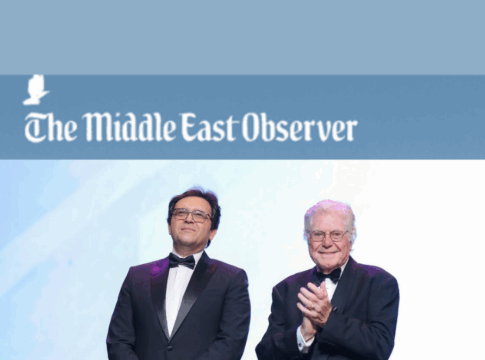
Festival President and veteran actor Hussein Fahmy, visibly shaken, stepped onto the stage.
“That voice you just heard could be mistaken for a dramatic scene, but it is tragically real,” he said. “Hind begged for life while the world watched and did nothing. Cinema must ensure that neither she nor thousands of children like her are erased from memory.”
Immediately after, the audience watched Kaouther Ben Hania’s searing short film The Voice of Hind Rajab, presented as CIFF’s final, deliberate statement—a reminder that cinema at its greatest is not entertainment, but evidence.
Yet the night was not solely one of mourning. As the lights rose, celebration returned, honouring the very craft that makes witness possible. The British drama Dragonfly captured the Golden Pyramid for Best Film, while its stars Andrea Riseborough and Brenda Blethyn shared the Best Actress Award in one of the evening’s most applauded wins.
Palestine stood tall on the winners’ stage as well. The acclaimed feature Once Upon a Time in Gaza swept the awards:
– Silver Pyramid for Best Director for Tarzan and Arab Nasser
– Best Actor for Majd Eid
– Best Arab Feature Film and its accompanying $10,000 prize
The film’s dominance underscored a larger truth shaping this year’s festival—art is at its most powerful when it refuses neutrality in the face of injustice.
Other major laureates included:
– The Things You Kill, winner of the Naguib Mahfouz Award for Best Screenplay and the FIPRESCI Prize
– Sand City, whose cinematographer Mathieu Giombini earned the Henry Barakat Award for Best Artistic Contribution
– As We Breathe, receiving the Bronze Pyramid Special Jury Award
– Souraya Mon Amour, named Best Documentary
– The Botanist, winner of the NETPAC Award for Best Asian Film
– ONE MORE SHOW, awarded the Youssef Sherif Rizkallah Audience Award
With 153 films from 55 countries, restored classics, packed masterclasses, and an energetic Festival Market, CIFF once again reaffirmed why it remains one of the Arab world’s, Africa’s, and the Middle East’s most enduring cultural institutions since its founding in 1976.
Fahmy closed the ceremony by thanking the Ministry of Culture, state bodies and sponsors, and announced a new cooperation agreement with the Doha Film Institute, signalling an expanded regional cinematic alliance.
But the evening belonged to Hind.
A festival that began with celebration ended with truth—with the raw, unfiltered reminder that cinema’s first duty is memory, its greatest weapon is testimony, and its most sacred role is to stand with the vulnerable. On this closing night, CIFF did more than award films. It confronted the powerful, honoured the innocent, and declared that stories like Hind Rajab’s will never again be silenced.