
For more than half a century, the Cairo International Book Fair (CIBF) has been defined by scale. Founded in 1969, the fair grew into the largest book event in the Arab world and one of the most heavily attended cultural gatherings globally. What distinguishes Cairo from almost every other major international fair is not only the number of exhibitors, but the intensity of public engagement: long queues, packed halls, and an ecosystem in which books are bought, debated and carried home in volume.
The 57th edition of CIBF in 2026 reaffirmed that identity—while also underlining how the fair is steadily evolving into a regional hub that blends culture, commerce, education and soft-power diplomacy.
This year’s fair brought together 1,457 publishers from 83 countries, representing 6,637 exhibitors, alongside more than 400 cultural events and panel discussions. Daily footfall reached into the hundreds of thousands, peaking sharply on Fridays and Saturdays, when the halls became densely crowded with families, students and professionals.
The fair’s enduring retail engines—the Children’s Pavilion and the historic Al-Azbakeya Wall—once again proved central. Discounted books, educational titles and classics moved in extraordinary volumes, reinforcing Cairo’s role as a physical book market first, trade fair second. For many regional publishers, CIBF remains the single most important sales moment of the year, capable of absorbing print runs at a speed rarely seen elsewhere.
Romania as Guest of Honour: Literature as Diplomacy
This year’s Guest of Honour, Romania, brought a distinct cultural and diplomatic dimension to the fair. The invitation coincided with the celebration of 120 years of diplomatic relations between Egypt and Romania, giving the programme additional symbolic weight.
Romania’s pavilion, themed “Books for Friends: From the Danube to the Nile,” prioritised dialogue over deal-making. It hosted readings, discussions and exhibitions designed to introduce Romanian literature to Arab audiences while highlighting shared historical and intellectual currents.
Among the most prominent voices were Mircea Cărtărescu, whose novels Solenoid and Blinding featured in discussions on contemporary European fiction; poet Ana Blandiana, who led reflections on poetry, memory and freedom; Ioana Pârvulescu, presenting Life Begins on Friday; and novelist Dan Lungu, whose work sparked debate on post-communist society and narrative realism.
While Romania’s presence was not framed around immediate commercial outcomes, several publishers reported closing Arabic-language options on European fiction titles during the fair, with children’s and illustrated books dominating early commitments—confirming Cairo’s role as a gateway for exploratory translation rather than a deal-heavy rights marketplace.
International Publishing on the Ground
The most tangible trade activity at CIBF continues to take place in academic and professional publishing, where Cairo functions as a meeting point for universities, libraries and distributors across the Middle East and Africa.
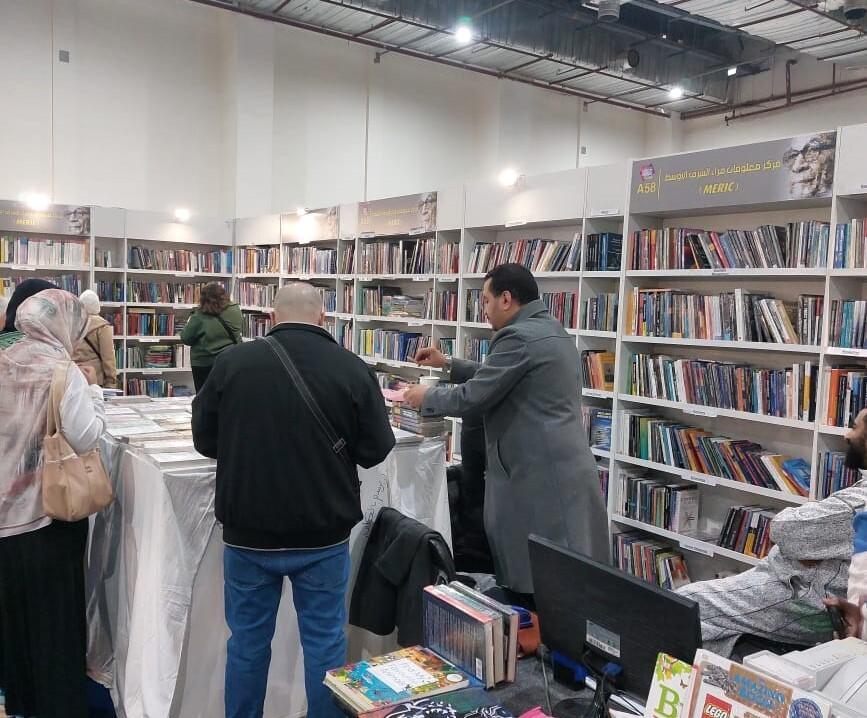
At the stand of Middle East Readers Information Center (MERIC), editor interviews highlighted how international content performs in this environment. Ahmed Aly, Director of MERIC and an agent for leading international publishers, said the stand attracted delegations from universities in Sudan, Jordan and Saudi Arabia, alongside strong representation from Egyptian public and private universities.
According to Aly, demand during CIBF 2026 focused squarely on high-value academic disciplines, including:
- Science and Engineering
- Computer Science and Artificial Intelligence
- Medical publishing, notably nursing and dentistry
- Business and management
He noted that the strongest-selling international lists were from Taylor & Francis and Springer, reflecting sustained institutional appetite for English-language STM content.
Pricing, Aly stressed, remains decisive. International publishers typically extend special fair pricing, making acquisitions viable for institutions, while Arabic publishers deploy aggressive discounts across trade and academic lists alike—one of the factors that continues to make Cairo commercially compelling.
Alongside print sales, Aly confirmed that early-stage discussions around digital access, structured academic content and AI-ready datasets—relevant to institutional AI and large language model (LLM) use—are beginning to surface, though they remain largely exploratory rather than contractual.
A Regional Intellectual Crossroads
Beyond sales, CIBF continues to function as a regional intellectual crossroads. Delegations from Africa and the Gulf were a visible presence throughout the fair, using Cairo as neutral ground for cultural exchange, educational cooperation and publishing dialogue.
For African publishers and institutions in particular, Cairo offers access to Arabic translation networks, printing infrastructure and distribution capacity at a scale difficult to replicate elsewhere. This reinforces the city’s historic role as a centre of Arabic publishing and intellectual circulation, now extending its influence southward as well as eastward.
A Fair That Plays to Its Strengths
CIBF’s strength lies in scale, immediacy and regional reach, offering publishers direct exposure to readers, educators and institutions in one of the world’s most linguistically and demographically significant markets.
If there is a recurring criticism of the fair, it lies in the very success that defines it. Extreme crowding—especially on peak days—poses logistical challenges for international exhibitors seeking structured meetings or quieter professional engagement. Several publishers noted that greater segmentation between public retail areas and professional spaces would enhance Cairo’s attractiveness as an international industry platform.
CIBF 2026 confirmed that the fair’s future is not about competing with rights-driven Western models, but about refining its own hybrid identity: a people’s fair, a regional marketplace, and an increasingly important gateway to education, culture and knowledge flows across the Arab world, Africa and the Gulf.