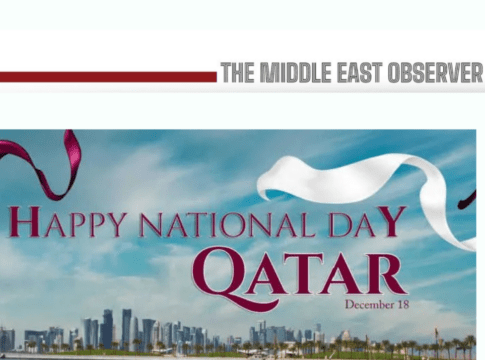
On 18 December, Qatar celebrates its National Day, commemorated annually in a tribute to the country’s founding, unity, and remarkable national journey. Known as Founder’s Day, the occasion honours the establishment of the modern Qatari state and the enduring values of loyalty, pride, security, and prosperity that continue to shape the nation.
Located in West Asia, Qatar is a peninsula defined by its striking contrast of desert landscapes and surrounding waters. With a population of approximately 3.1 million in 2024, the country has evolved into a global hub of diplomacy, energy, finance, and culture. Its capital, Doha, stands as a symbol of this transformation, renowned for its futuristic skyline, world-class infrastructure, and architectural designs that blend modern innovation with Islamic heritage.
Qatar’s modern history traces back to 1868, when leadership was consolidated under the House of Thani. Sheikh Jassim bin Mohammed Al Thani, the founder of modern Qatar, laid the foundations of statehood through wisdom, diplomacy, and resilience. His leadership prioritised security, justice, social cohesion, and economic stability, shaping a unified national identity.
In September 1971, Qatar gained full independence from the United Kingdom, emerging as a sovereign state. December 18 was designated National Day in recognition of Sheikh Jassim’s historic role and the enduring legacy of his leadership. Following his passing, leadership transitioned smoothly within the Al Thani family, reinforcing continuity and institutional strength.
Qatar today boasts one of the world’s highest per capita incomes, underpinned by vast natural resources. Oil and natural gas remain the backbone of the economy, accounting for more than 70 percent of government revenues, over 60 percent of GDP, and roughly 85 percent of export earnings. Qatar also holds the world’s third-largest proven natural gas reserves, cementing its position as a key global energy supplier.
Yet the country’s economic success is not built on hydrocarbons alone. Through Qatar National Vision 2030, the state has pursued a carefully calibrated development model that channels energy revenues into modernisation, diversification, human development, and sustainability. The strategy aims to reduce dependence on hydrocarbons while strengthening the private sector and knowledge-based industries.
In 2024, Qatar recorded strong foreign trade performance, with exports estimated at QR 346 billion and imports at around QR 130 billion, generating a substantial trade surplus. Energy products led exports, with China accounting for more than 20 percent, alongside South Korea and India. Major import partners included China, the United States, and Japan, with machinery and transport equipment among the top imports.
Economic indicators in 2025 reflect continued resilience. Real GDP growth is estimated at 2.8–2.9 percent, driven largely by non-hydrocarbon sectors such as tourism, financial services, logistics, and culture. Inflation has remained contained at around 1.2 percent, reinforcing macroeconomic stability. International institutions, including the World Bank, have highlighted Qatar’s balanced growth outlook and strong fiscal buffers.
Qatar National Day celebrations also highlight the country’s expanding regional partnerships, notably with Egypt. In 2024, Egyptian exports to Qatar reached approximately $93.4 million, spanning agricultural products, electrical equipment, food preparations, furniture, machinery, iron and steel, and chemicals. Imports from Qatar to Egypt stood at around $35 million.
Investment ties continue to deepen. Qatari investments in Egypt reached $618.5 million in 2024, while Egyptian investments in Qatar amounted to $171.5 million. In 2025, both countries moved to activate a long-discussed investment framework, formalised through agreements covering pensions, agriculture, and political consultation, signed in August.
A flagship example of this cooperation is the Alam El-Roum Project, announced in November 2025 by Qatari Diar. Spanning 4,900 feddans, the development is set to become one of the largest integrated urban projects in modern Egyptian history, featuring international hotels, residential communities, commercial and tourism centres, healthcare facilities, and educational institutions.
As Qatar marks its National Day in 2025, the celebration reflects not only a proud past but also a confident future. From its historical foundations under Sheikh Jassim bin Mohammed Al Thani to its present role as a global energy leader and diplomatic actor, Qatar’s journey stands as a testament to strategic vision, unity, and adaptability.
The National Day serves as a moment of collective pride for Qataris and residents alike—celebrating a nation that has transformed natural wealth into lasting development, regional partnerships, and an increasingly influential global presence.