
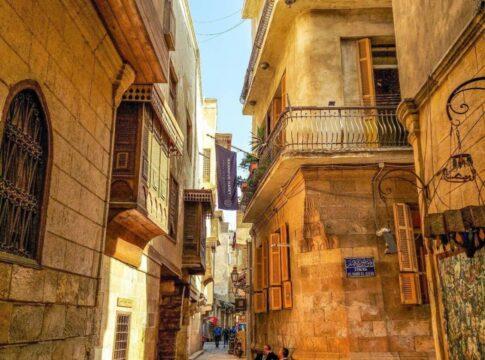
In most walking tours, it’s the narrow, tucked-away alleys that reveal the true pulse of a city. In Cairo, these spaces are not just shortcuts between neighborhoods—they are living testaments to a millennium of artistry, commerce, and daily life. Nowhere is this more evident than in Al-Darb al-Asfar, a winding historic passage in the heart of Fatimid Cairo, and it’s beating heart: the Coppersmiths’ Market (Souq al-Nahhasin).
Walking these alleys feels like stepping into an open-air museum. The scent of spices mingles with the metallic clang of hammers on copper, while wooden mashrabiya balconies cast patterned shadows on the cobblestones. For centuries, this quarter has been a magnet for artisans, scholars, and travelers—its energy preserved in both architecture and craft.
Historians debate the origins of Al-Darb al-Asfar’s name. Some suggest its walls were once painted a golden-yellow hue; others trace it to the glow of brass and copper workshops that still operate there today. The alley connects the bustling district of Al-Moski with the famed Al-Gamaliya quarter, intersecting with Al-Muizz Street, one of Cairo’s oldest thoroughfares, first laid out in the 10th century.
Here stands Bayt al-Suhaymi, a 17th-century Ottoman-era mansion once owned by Sheikh Amin al-Suhaymi, a scholar of Al-Azhar. Today it hosts cultural events—shadow plays, puppet shows, and concerts by the Nile Folk Ensemble—reviving traditions that once filled Cairo’s homes and streets. Nearby, Bayt Mustafa Ja’far al-Silahdar and the Suleiman Agha al-Silahdar Mosque bear witness to centuries of Ottoman patronage, blending marble, mashrabiyas, and Islamic artistry.
Just a few steps away, the legendary Khan al-Khalili bazaar beckons with spices, fabrics, perfumes, and jewelry. Yet it is Souq al-Nahhasin—the coppersmiths’ market—that resonates with a deeper, more elemental music.
Since the Fatimid era, the rhythmic hammering of copper has echoed through this quarter. Here, artisans still forge cooking pots, trays, lanterns, and jewelry much as their ancestors did. “Copper never loses value; it appreciates with time,” explains Mahmoud Ali, a third-generation coppersmith, as he polishes a massive fava bean pot. “But finding skilled craftsmen today is rare. The work is hard, and copper is expensive.”
Indeed, the craft is struggling. Cheaper aluminum and stainless steel have largely replaced copper in Egyptian kitchens, and many workshops have shuttered. Once, a bride’s dowry was incomplete without gleaming copper utensils; today, buyers are more often foreign tourists or Egyptian collectors.
Still, the trade holds prestige. As anthropologist Laila Ahmed of Cairo University notes, “Copperware was not just utilitarian—it symbolized wealth, durability, and hospitality. To own it was to display refinement. Today, it survives as a cultural capital, linking modern Egypt to its artisanal roots.”
Despite economic pressures, Souq al-Nahhasin experiences a seasonal revival each Ramadan. Copper lanterns, trays, and teapots add an authentic Oriental charm to Cairo’s streets and hotels, their glow synonymous with festive evenings. When Ramadan coincides with peak tourism—as it does this year—the market comes alive. “This is our busiest season,” says Ahmed Hassan, a workshop owner. “Hotels order decorations, tourists buy souvenirs, and for a few weeks, the trade feels like it used to.”
Younger designers are also breathing new life into the craft, creating copper jewelry and accessories that appeal to modern tastes. “We don’t just sell to tourists,” says Fatma El-Sayed, a young artisan whose bracelets and earrings blend tradition with contemporary design. “Egyptians are rediscovering copper as fashion.”
Egypt’s Ministry of Tourism and Antiquities has begun highlighting artisanal quarters like Souq al-Nahhasin as part of its heritage preservation strategy. According to ministry figures, heritage tourism contributes nearly 12% of Egypt’s GDP, with markets like Khan al-Khalili and Al-Darb al-Asfar drawing millions annually. UNESCO has also recognized Historic Cairo as a World Heritage Site since 1979, underscoring the global value of its craft traditions.
“Handmade crafts are not only cultural artifacts, they are economic assets,” explains Dr. Mohamed Serag, an economist specializing in heritage economies. “Supporting artisans means sustaining livelihoods, diversifying tourism, and preserving intangible heritage. Every copper pot sold is a transaction that links past and present.”
As evening falls, light reflects off the polished copper trays stacked outside the shops, casting a golden hue across the alley. The sound of a hammer striking metal mingles with the call to prayer from nearby mosques, a reminder that Cairo’s history is still alive, not trapped in museums but carried in its streets.
Souq al-Nahhasin is more than a market—it is a story of survival, adaptation, and endurance. For travelers, it offers not just souvenirs, but a chance to carry home a piece of Cairo’s soul. For Cairo itself, it remains a living heritage, where every hammer strike keeps the past alive.