
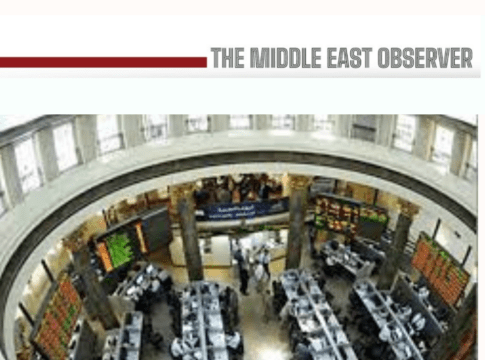
By the close of trading on Thursday, 8 January, the Egyptian Exchange showed a clear divergence in performance across indices. The benchmark EGX30 advanced 0.75% to 41,856.76 points, consolidating its position above the 41,000 level reached at the end of last year. The Shariah-compliant EGX33 also posted gains, rising 0.52% to 4,600.94 points, signalling continued interest in defensive and income-generating names.
In contrast, broader market breadth weakened. The EGX35-LV edged up only marginally by 0.09%, while the SME-focused EGX70 fell 0.65% to 12,941.85 points. The wider EGX100 declined 0.55% to 17,218.46 points, highlighting pressure on second- and third-tier stocks after the strong rallies recorded in late 2025.
Market capitalization stood at approximately EGP 2.99 trillion, broadly stable week-on-week, suggesting that gains in blue chips largely offset declines elsewhere.
Foreign participation remained the dominant driver of market direction during the week. Non-Arab foreign investors were strong net buyers, injecting more than EGP 15.08 billion, while Arab investors added a further EGP 2.66 billion. This inflow provided clear support to the main index and helped absorb selling pressure.
Egyptian investors, by contrast, were net sellers to the tune of roughly EGP 17.74 billion. This pattern is consistent with ongoing portfolio rebalancing at the start of the year, as local investors lock in profits after 2025’s exceptional performance and reallocate liquidity across asset classes.
On the gainers’ side, Prime Holding continued to attract speculative and momentum-driven interest, rising 8.43% to EGP 1.80 per share. Alexandria National Company for Financial Investment advanced 7.58% to close at EGP 92.51, supported by renewed interest in financial services stocks. Al Khair River for Development Agricultural Investment & Environment gained 6.02%, reflecting selective appetite for agri- and development-linked names.
Losses were concentrated in a small number of stocks, most notably the subscription rights of Atlas for Investment and Food Industry, which fell sharply by 19.27%. Sabaa International Company for Pharmaceutical and Chemical declined 6.78%, while Atlas for Investment and Food Industries dropped 6.67%, indicating sector-specific corrections rather than broad-based weakness.
The mixed performance of the first week of January points to a market entering a consolidation phase rather than reversing its broader upward trend. Foreign inflows, stable macro expectations, and anticipation surrounding government IPOs continue to underpin sentiment. However, near-term volatility in small- and mid-cap stocks is likely as investors reassess valuations following last year’s rally.
Overall, the week suggests a more selective and fundamentals-driven market environment in early 2026—one in which large-cap stability and foreign participation remain key anchors, while broader gains will depend on liquidity flows and progress on planned listings.