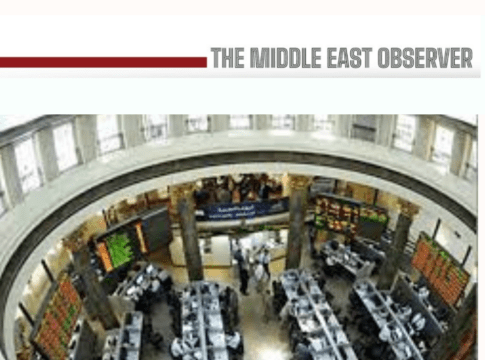
Egypt’s equity market closed 2025 on a firm footing, capping one of its strongest years in decades and setting the stage for a potentially transformative 2026. On the final trading session of the year, Wednesday 31 December, the Egyptian Exchange ended mostly in positive territory, underscoring investor confidence as the market heads into the new year.
The benchmark EGX30 index rose 0.33% to 41,828.97 points, consolidating gains after crossing the 41,000 mark for the first time in its history. Shariah-compliant stocks outperformed, with the EGX33 advancing 1.07% to 4,597.77 points, while the EGX35-LV climbed 0.61%. The broader EGX100 added 0.18%, even as the SME-focused EGX70 edged down slightly by 0.14%.
Market capitalisation approached the psychologically important EGP 3 trillion level, reaching nearly EGP 2.999 trillion by year-end. Foreign participation remained a defining feature of the session: Arab and non-Arab investors were net buyers, while Egyptian investors booked profits after a year of exceptional returns.
Beyond the final session’s numbers, 2025 stands out as a watershed year. The EGX30 surged by almost 40% over the year, up from around 30,000 points at the start of January. Mid- and small-cap stocks delivered even stronger performances, with the EGX70 gaining more than 60% and the EGX100 rising about 55%. Market capitalisation expanded by roughly EGP 800 billion over the year, reflecting both price appreciation and improving corporate fundamentals.
Market participants describe 2025 as a “harvest year” for equities, driven by a rare alignment of macroeconomic stabilisation and supportive monetary policy. The March 2024 currency adjustment helped eliminate the parallel foreign-exchange market and restore confidence in the exchange rate, while inflationary pressures gradually eased. These shifts fed directly into stronger corporate earnings and higher dividend payouts.
At the same time, aggressive monetary easing altered investor behaviour. With the Central Bank of Egypt cutting interest rates by a cumulative 725 basis points in 2025, traditional savings instruments lost some of their appeal, pushing liquidity toward equities and risk assets.
Despite the stellar performance, the rally exposed structural shortcomings. Only a handful of new companies joined the exchange during the year, and most listings involved transfers from the secondary market rather than fresh initial public offerings. Long-anticipated state-owned company IPOs—widely seen as essential to deepening liquidity and attracting long-term foreign capital—were repeatedly delayed.
As a result, valuations remain relatively modest by regional standards, and trading volumes, while improving, have not fully matched the scale of price gains. For many investors, 2025’s strength was achieved despite, rather than because of, market depth.
Looking ahead, analysts see 2026 as a year that could consolidate and broaden the gains of 2025. The government has reiterated its commitment to relaunching the state IPO programme, with several companies reportedly being prepared for market listing across a wider range of sectors. If delivered, these offerings could mark a structural shift for Egypt’s capital markets.
An additional catalyst is expected early in the year, as high-yield bank certificates offering returns of up to 27% mature in January 2026. These instruments absorbed an estimated EGP 1.3 trillion during their issuance. With bank yields now trending lower, a portion of this liquidity is likely to seek alternative outlets, including equities.
If macroeconomic stability is maintained and the IPO pipeline materialises, 2026 could become a pivotal year—one that builds on the exceptional returns of 2025 while addressing long-standing gaps in market depth and diversification. For investors, the message from Cairo is clear: the Egyptian Exchange has re-established itself as a serious regional market, and the next phase will be defined less by momentum alone and more by breadth, liquidity, and institutional participation.