
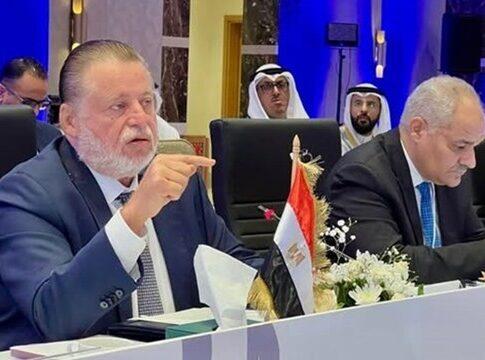
At t the 49th Annual Meeting of the Council of Arab Central Banks and Monetary Authorities’ Governors, held last week in Tunisia, Egypt’s Central Bank Governor Hassan Abdalla delivered a pointed message: “Encouraging increased domestic production and strengthening productive capacities are two core pillars in containing inflationary pressures and achieving long-term economic stability.”
His words echo, almost verbatim, the late Ahmed Fouda, owner of The Middle East Observer, who a decade earlier distilled Egypt’s economic dilemma into a single dictum: “Production is the buzzword, it is the door to curbing unemployment, inflation and a country’s survival.” Fouda, who passed away in 2015, articulated his belief at a time when Egypt’s economy was reeling from the aftershocks of the Arab Spring, double-digit inflation, and foreign exchange shortages. His view—that only domestic productive growth could generate jobs, stabilize prices, and guarantee sovereignty—was strategic rather than rhetorical.
In Fouda’s era, the challenge was structural unemployment, rising subsidies, and reliance on imports to meet domestic demand. With inflation creeping into double digits and foreign reserves under strain, the call for production was a response to fragility in Egypt’s economic fundamentals.
By contrast, Abdalla’s remarks today come against the backdrop of global fragmentation. Trade wars, heightened geopolitical risks, and the inflationary waves following the pandemic and the Russia-Ukraine conflict have forced central banks worldwide to recalibrate. Egypt’s economy, liberalized after the March 2024 currency float and buoyed by new IMF-backed reforms, faces a different yet familiar challenge: ensuring that production—not just monetary tightening—anchors inflation control and sustainable growth.
Abdalla’s emphasis on production is notable for a central banker, whose remit is typically confined to liquidity and price stability. By invoking supply-side capacity, he effectively links monetary resilience to industrial policy. This is an acknowledgment that Egypt cannot tame inflation or build resilience purely through interest-rate policy or reserve management; it must expand its domestic base of goods and services.
Fouda’s vision anticipated this by a decade: that macroeconomic stability hinges less on imported liquidity and more on the dynamism of domestic factories, farms, and SMEs. For Fouda, production was not just an economic tool but a doctrine of national survival.
The Tunis meeting underscored other themes—cybersecurity, digital payments, financial inclusion, and anti-money laundering frameworks. Yet Abdalla’s intervention placed Egypt firmly within the global debate: how emerging economies can withstand external shocks by deepening internal production. In this sense, Abdalla’s comments represent a continuity of Fouda’s strategic vision, updated for the modern era of digitisation and trade fragmentation.
Both men, though from different vantage points—one as a newspaper owner and business strategist, the other as a central banker—converge on the same conclusion: production is Egypt’s lifeline. Where Fouda saw it as the foundation for employment and social stability, Abdalla frames it as the necessary supply-side anchor to monetary and financial stability in an age of global volatility.
The strategic lesson is clear: Egypt’s survival and prosperity cannot be secured through financial engineering alone. As Fouda insisted, and as Abdalla now reaffirms, the answer lies in the country’s ability to produce more, better, and sustainably.
