
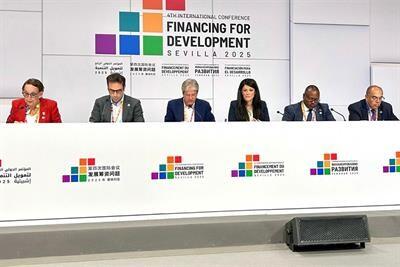
The announcement was made during a high-profile session titled “Debt Solutions for Resilience and Reform: Financing the 2030 Agenda in Africa and Beyond.” This session was part of the Fourth International Conference on Financing for Development (FfD4), held from June 30 to July 3 in Seville, Spain. The conference aimed to advance Sustainable Development Goals (SDGs) and reform the international financial architecture.
Minister Al-Mashat’s speech underscored the growing debt burdens faced by developing nations. According to the Ministry of Planning, Economic Development, and International Cooperation, low- and middle-income countries saw their external debt soar to an unprecedented $8.8 trillion in 2023, with debt servicing costs reaching $1.4 trillion. Excluding China, this figure still approaches $1 trillion—doubling from ten years ago. “Over 60 percent of low-income countries are now in or near debt distress,” Al-Mashat noted, signaling a critical need for systemic reform.
Al-Mashat advocated for a more adaptive global financial system, calling for transparent and equitable approaches to sovereign debt management. She proposed the establishment of a global platform to exchange expertise and provide technical support for innovative financing and debt swap initiatives. Emphasizing a need for responsible lending practices, she also highlighted the importance of automatically suspending debt during crises.
The minister further urged multilateral development banks to broaden their use of Special Drawing Rights (SDRs), blended finance, and liquidity tools to combat global issues like climate change. These proposals aim to promote sustainable economic development and enhance financial stability for vulnerable economies.
Economic analysts view Egypt’s strategic debt swaps as a positive move towards fiscal health. Dr. Ahmed Khalil, an economist at the Cairo Institute for Economic Studies, remarked, “Egypt’s approach to debt management through swaps not only alleviates immediate financial pressures but also sets a precedent for other nations grappling with similar challenges.”
The agreements with Germany, Italy, and China reflect Egypt’s commitment to forging strong international partnerships and exploring innovative financial solutions. These efforts are seen as vital to achieving long-term economic resilience and supporting the global reform agenda outlined at the FfD4.