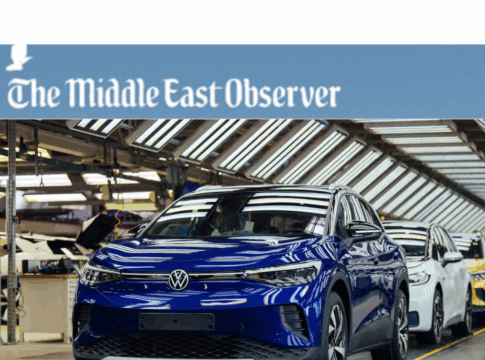
Germany’s Volkswagen Group has entered a pivotal stage in its long-term automotive investment plans for Egypt, as the government confirmed progress in the feasibility study for a $240 million electric-vehicle (EV) manufacturing and localization project. While no final investment decision has yet been announced, the current phase represents the most advanced engagement between the German automaker and Egypt since the signing of the cooperation framework in 2023.
The Ministry of Industry and Transport revealed that the study is being conducted in coordination with Egyptian German Automotive (EGA), Volkswagen Group’s leadership in Africa, and senior members of its global executive team. The discussions, which took place via video conference led by Minister Kamel Al-Wazir, reaffirm Volkswagen’s interest in positioning Egypt as a competitive production base for future EV lines targeted at regional and international markets.
According to the ministry’s statement, Volkswagen is currently evaluating the localization of EV assembly in Egypt through EGA’s existing facility as an interim production solution. This approach allows the company to assess supply-chain readiness, production volumes, and regulatory incentives before committing to building its own plant.
The long-term plan under review would see Volkswagen establish a dedicated manufacturing facility in East Port Said, located within the Suez Canal Economic Zone (SCZONE)—an area increasingly marketed as a strategic automotive hub linking Europe, Africa, and Gulf markets. The feasibility study will determine infrastructure requirements, local supplier capabilities, export potential, and the financial model for the proposed East Port Said Automotive Zone (EPAZ).
Officials noted that timelines remain under evaluation and will be confirmed only after the study’s completion.
The project is being examined within the framework of the Automotive Industry Development Programme (AIDP), the national strategy aimed at creating a globally competitive automotive base in Egypt. The AIDP offers tiered incentives for the production of electric vehicles, passenger cars, SUVs, vans, and microbuses, with particular emphasis on localization of components.
Minister of Finance Ahmed Kouchouk previously confirmed that EGP 1 billion has been allocated in the FY 2024/25 budget to support the program’s rollout and attract multinational manufacturers.
Volkswagen, in its preliminary engagements, identified Egypt’s skilled workforce, industrial base, and strategic geographic position as enabling factors for deeper manufacturing integration. The company also signaled plans to expand local component production, build a research and development center, and establish a technical training facility to support EV maintenance and technology transfer.
If Volkswagen proceeds to full implementation, the project could establish Egypt as one of the few EV-capable production hubs in the Middle East and Africa. Industry sources note that East Port Said’s proximity to European shipping lanes, coupled with SCZONE’s preferential access to African, Arab, and EU markets, positions Egypt as a logical candidate for a regional automotive export center.
Egypt’s participation in COMESA and AfCFTA further expands tariff-free access to over 1.3 billion consumers, creating downstream opportunities for exporting EVs and automotive components across the continent. Similarly, the automotive supply chains in the Eastern Mediterranean—Greece, Cyprus, Jordan, and Türkiye—could benefit from Egypt-based production, particularly in spare parts, components, and after-sales services.
Officials and analysts suggest that, with sustained government support and foreign direct investment, East Port Said could evolve into a full automotive ecosystem, increasing local value-added manufacturing, attracting battery-component suppliers, and positioning Egypt as a gateway for EVs entering African and Middle Eastern markets.
According to preliminary projections cited by the ministry, Volkswagen’s proposed localization program could create 2,100 direct jobs and an additional 4,000 indirect jobs, while stimulating growth in Egypt’s emerging EV industry. The project is also expected to strengthen Egypt’s industrial exports, align with its national economic narrative, and support its broader goal of increasing private-sector participation under the IMF’s Extended Fund Facility (EFF).
While the feasibility study remains ongoing, the clarity and depth of the discussions suggest a maturing partnership between Volkswagen and Egypt. The final investment decision—expected after technical, financial, and logistical assessments—will determine whether the East Port Said site becomes a cornerstone of Volkswagen’s African strategy and a future production base for electric and next-generation vehicles.
For now, the study marks a significant milestone and a strong indicator that Egypt could soon emerge as a competitive automotive and EV manufacturing hub serving regional and global markets.