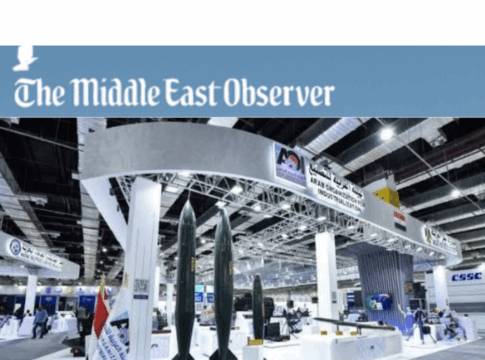
The fourth edition of the Egypt Defence Expo (EDEX 2025) concluded in Cairo with a wave of new industrial partnerships, co-production agreements, and technology-transfer frameworks that underscore Egypt’s accelerating shift from an import-dependent defence buyer to a regional manufacturing hub. The exhibition, attended by more than 55 countries and 400 exhibitors, served as a major platform for Cairo to strengthen ties with partners from China, the UAE, Türkiye, Pakistan, and France, with notable emphasis on unmanned systems, aerospace maintenance, and advanced electro-optics.
Media outlets across Egypt, the region, and internationally — including Ahram Online, Daily News Egypt, Amwal Al Ghad, Army Recognition, Military Africa, Anadolu Agency, and Thales Group — reported a consistent pattern: EDEX 2025 marked Egypt’s most ambitious industrial defence showcase to date, with nearly all agreements centred on technology localisation and joint production.
Egypt’s Arab Organization for Industrialization (AOI) opened the event with a strategic defence-manufacturing MoU with China’s Norinco aimed at expanding joint production of land systems and unmanned platforms. According to the State Information Service, the agreement includes deep localisation within AOI’s Aircraft Factory, while Army Recognition and Military Africa highlighted the operational core of the deal — the co-production of the Hamza-2 armed tactical UAV, based on China’s ASN-209 family and assembled in Egypt with export prospects.
Simultaneously, AOI signed seven cooperation agreements with the UAE’s Abu Dhabi Aviation Group and its subsidiaries Maximus Air, GAL, and AMMROC. Local media reported that these agreements encompass joint aircraft and component manufacturing, comprehensive MRO (maintenance, repair and overhaul) services, and spare-parts localisation across AOI’s Aircraft, Engine, and Helwan factories. UAE defence outlets described the package as reinforcing the Egypt–UAE industrial corridor and positioning Egypt as a regional support hub for both fixed- and rotary-wing fleets. AOI also concluded an MoU with the UAE–Chinese consortium Al Qalaa Red Flag to establish new defence production lines in Egypt, with SIS confirming that the agreement carries an export-oriented mandate for African and Arab markets.
On the second day of the expo, AOI signed another major Chinese agreement with Shadow Wings, focusing on advanced unmanned systems, defence electronics, and composite materials. Amwal Al Ghad described the deal as a significant localisation initiative for “modern defence technologies,” while Zawya and Military Africa viewed it as a major step toward expanding China’s high-tech industrial footprint inside Egypt.
One of the most strategic agreements of the exhibition emerged through a wide-ranging MoU between AOI and Pakistan’s Global Industrial & Defence Solutions (GIDS). Egyptian media reported a comprehensive framework covering missile systems, UAVs, and counter-UAS technologies. Pakistani defence outlets, including Global Defense Insight and GIDS’ official communications, confirmed joint collaboration on the Safrah-III missile platform, RAAST counter-UAS systems, and BLAZE loitering munitions — marking the strongest military-industrial partnership between Egypt and Pakistan in years.
The third day of EDEX witnessed the show’s most expansive industrial announcement as Thales and Egypt’s Arab International Optronics (AIO) concluded a six-pillar strategic partnership. The agreement includes the establishment of Thales Academy in Egypt for advanced training in cybersecurity, radars, optronics, artificial intelligence, and secure communications; next-generation fire-control systems for heavy armour; co-development of a laser-guided rocket-capable RCWS based on AIO’s X29; integrated ground-surveillance systems; a local maintenance centre for Thales’ HHTI thermal imagers; and AIO’s integration into Thales’ global supply chain. Thales emphasised that over 800 specialised engineers in Egypt are already engaged in joint projects, describing the partnership as a major step toward enhancing Egypt’s “technological independence.”
In parallel, AOI’s Engine Factory signed an MoU with French aerospace specialist Sofema to localise overhaul work for LARZAC engines used on Alpha Jet aircraft. SIS noted that Egypt will establish a regional MRO hub capable of servicing fleets from neighbouring states, further solidifying Cairo’s ambitions in aerospace support and maintenance.
Egyptian–Turkish defence cooperation also advanced meaningfully at EDEX 2025 with the debut of two jointly developed platforms: the Hamza-1 VTOL UAV, co-produced with Türkiye’s Havelsan, and the Aqrab (Akrep) 6×6 unmanned ground vehicle for reconnaissance and armed operations. Anadolu Agency confirmed that the UAV is already under co-production in Egypt, while Egyptian media reported AOI’s intent to integrate both systems into its domestic manufacturing pipelines. The unveiling of these platforms quickly became one of the most discussed developments of the show.
Across coverage from Army Recognition, DefenceWeb, Military Africa, TRT World, and Egyptian news sources, several systems stood out as the show’s most notable revelations. The Hamza-1 VTOL UAV was widely interpreted as a strategic milestone symbolising renewed Egyptian–Turkish technical convergence and Egypt’s entrance into modular VTOL capabilities. The Hamza-2 UAV, emerging from Egypt–China cooperation, drew strong attention for representing Egypt’s most advanced Chinese-origin UAV configuration to date, with clear export potential. The Aqrab 6×6 armed UGV attracted praise as Egypt’s first publicly presented armed unmanned ground platform, reflecting AOI’s expanding role in robotics. European defence media highlighted the depth of the Thales–AIO fire-control systems collaboration, while South Korean-origin vehicles such as the K10EGY ammunition resupply vehicle and the debuting K11-N coastal fire-direction variant were noted as surprising and significant additions to Egypt’s evolving land-systems portfolio.
EDEX 2025 ultimately reinforced Egypt’s trajectory toward becoming a regional defence exporter. With more than 20 localisation-oriented agreements, Cairo is positioning itself to export UAVs, UGVs, armoured-vehicle upgrade kits, advanced electronics, optronics, and aircraft components. The show also illuminated the formation of new multinational co-production corridors linking Egypt with China, the UAE, and Türkiye, while agreements with Sofema, Thales, and Abu Dhabi Aviation strengthened Egypt’s aspiration to become Africa’s primary airframe and engine MRO centre.
Looking ahead to EDEX 2027, regional defence intelligence platforms anticipate further progress in joint missile development with Pakistan, expanded Egyptian–Turkish naval systems cooperation, deeper integration of Chinese avionics into AOI production lines, and a likely expansion of Thales Academy into civilian cyber and digital-security training. EDEX 2025 therefore stands as a landmark edition, positioning Egypt not only as a major defence market, but as an increasingly influential manufacturer and exporter in the regional and global defence landscape.deskt