
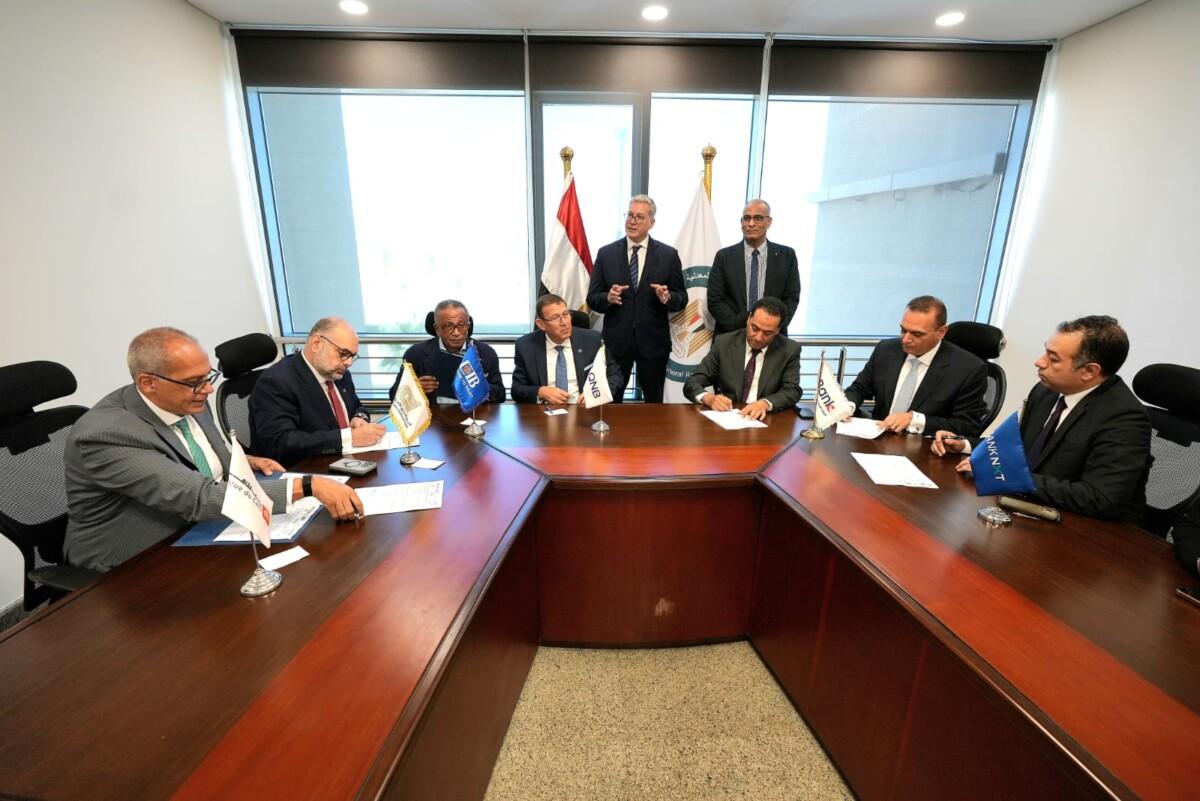
Minister of Petroleum and Mineral Resources Eng. Karim Badawi oversaw the signing of a Maga financing agreement for the Egyptian Soda Ash Company’s flagship production facility in New Alamein. The deal, worth approximately $490 million, brings together a powerful coalition of Egyptian and regional banks, signaling strong investor confidence in the nation’s petrochemical sector.
The signing, held in El Alamein City, formalized an agreement of principles between the Egyptian Soda Ash Company—a subsidiary of the Egyptian Petrochemicals Holding Company (ECHEM)—and leading financing institutions, including the National Bank of Egypt (NBE), African Export-Import Bank (Afreximbank), Qatar National Bank, Commercial International Bank (CIB), Arab African International Bank, Kuwait National Bank, Banque du Caire, and the Export Development Bank of Egypt.
The plant is set to produce 600,000 tons of soda ash and derivatives annually, making it one of the largest industrial projects of its kind in the region. Soda ash—a key ingredient in glass, detergents, paper, food processing, pharmaceuticals, and chemicals—is currently imported to meet local demand, costing Egypt hundreds of millions of dollars each year.
Minister Badawi underscored the project’s alignment with Egypt’s Vision 2030, emphasizing that localizing soda ash production will reduce the import bill, support sustainable development in new urban communities, and stimulate export opportunities.
“This project represents a qualitative leap for Egypt’s petrochemical industry, enabling us to not only meet domestic demand but also compete in global markets,” Badawi said, adding that the ministry and ECHEM are “fully committed to expediting implementation according to schedule.”
Industry experts note that this development could significantly alter Egypt’s trade balance in chemicals. According to Dr. Hany El-Sharqawi, a chemical industry analyst at the Arab Industrial Development Organization, “Egypt imports nearly all of its soda ash, creating a dependency that strains foreign currency reserves. This project could save the country up to $300 million annually and position it as a regional exporter within five years.”
Beyond the economic impact, the New Alamein project is expected to generate thousands of direct and indirect jobs during construction and operation. The plant will also introduce advanced manufacturing technology to Egypt, enhancing local capabilities in chemical processing.
“This is not just an industrial project—it’s a knowledge transfer platform,” said Eng. Ibrahim Mekki, ECHEM Chairman. “We are bringing in global-standard manufacturing processes that will spill over into other industrial sectors.”
The financing package’s broad participation highlights trust in Egypt’s economic outlook, particularly in energy-linked industries. Afreximbank’s Head of Financial Markets and Advisory, Hatem El Demerdash, described the agreement as “a testament to the resilience and long-term potential of Egypt’s industrial sector.”
The National Bank of Egypt’s Deputy CEO, Soha El Turki, echoed this sentiment, stating, “Our role as lead arranger reflects our belief in the strategic importance of this project, both economically and socially.”
While no official commissioning date has been announced, officials suggest that construction could begin before the end of 2025, with commercial production starting by 2028. If completed on schedule, Egypt could transition from being a net importer to a net exporter of soda ash by the early 2030s.