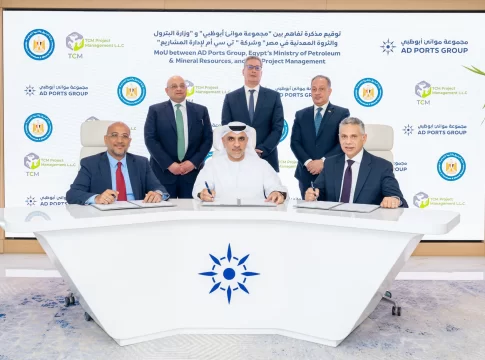
AD Ports Group, Egypt’s Ministry of Petroleum & Mineral Resources, and TCM Project Management signed a Memorandum of Understanding (MoU) to explore joint operation and development of Egypt’s strategic crude oil storage facilities.
Presented in the presence of Minister Karim Badawi, Egyptian Ambassador to the UAE Sherif Mahmoud Issa, and TCM CEO Tamer Al Zeyadi, the agreement was signed by Ahmed Al Mutawa (Regional CEO, AD Ports Group), Nasser Shoman (Undersecretary of Egypt’s Petroleum Ministry), and Mahmoud Farrag Omran (GM, TCM).
Egypt’s crude oil storage system is pivotal to its national energy value chain, offering a vital hub for domestic supply and international trade routes. The MoU brings together Egypt’s established infrastructure and AD Ports Group’s port, logistics, and digital operations to explore enhanced efficiency, cybersecurity, supply chain resilience, and modernization through digital transformation.
Minister Karim Badawi framed the cooperation within Egypt’s strategic framework to maximize petroleum-asset value and enhance regional energy integration, particularly with the UAE—a long-time strategic partner across upstream, midstream, and downstream energy sectors. “This partnership falls under core pillars of our integrated strategy to intensify sector cooperation and optimize Egypt’s advanced petroleum assets,” he stated.
Meanwhile, AD Ports CEO Mohamed Juma Al Shamisi described the deal as a reflection of UAE-Egypt economic alignment and a cornerstone for utilizing AD Ports’ synergies—including economic zones, maritime, and digital logistics—to drive long‑term industrial development.
This MoU builds on AD Ports Group’s deepening engagement in Egypt since 2022 with commitments totaling nearly USD 469 million, spanning port concessions, logistics parks, and multipurpose terminals. The new initiative signals a strategic leap from shipping infrastructure into energy logistics and storage. “Storage infrastructure is increasingly central to energy security strategy. This foundational move aligns Egypt’s resource base with global logistics capabilities,” noted Dr. Omar Naguib, Energy Strategy Analyst at the Cairo Energy Observatory.
With global oil volatility and emerging supply chain risks, scalable and modern storage is critical for both price stability and export resilience. Experts see the MoU as a signal that Egypt is positioning its oil infrastructure for greater integration in international energy markets.
While the MoU is exploratory, insiders indicate that technical due diligence is underway, with potential space for third-party investment and digital transformation pilots, including AI-enabled terminal monitoring and port‑to‑terminal integration.
Sources suggest more detailed agreements could be announced in late 2025, subject to regulatory review and feasibility outcomes. “Expect announcements on volume capacity, digital integrations, and perhaps expansion into refined product storage within 12 months,” predicts Ayman Galal, former logistics advisor to the Egyptian Investment Authority.
The agreement reflects broader economic cooperation ambitions between Egypt and the UAE. Beyond ports and industry zones, AD Ports has already signed logistics MoUs with Egypt’s Ministry of Industry & Transport and SCZONE, and holds long-term development concessions in Safaga, East Port Said, and Alexandria.
Its integrated model encompasses ports, shipping, economic zones, logistics, and digital platforms, positioning AD Ports as a multi-dimensional investor in Egypt’s macro infrastructure vision.