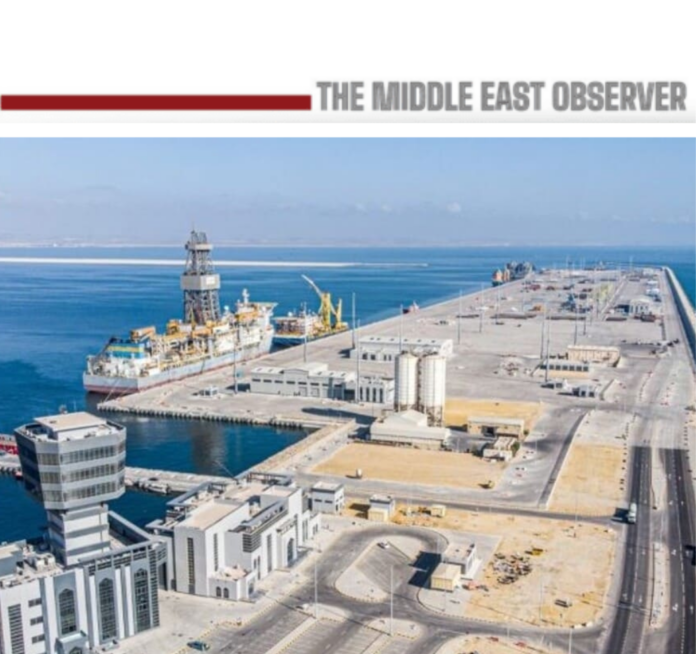
MUSCAT — Oman’s Economic Upswing gathered pace this week after the Sultanate secured nearly $7.5 billion in new investment commitments for projects in the Special Economic Zone at Duqm, reinforcing the country’s emergence as a regional hub for green energy, advanced manufacturing, logistics and industrial development.
The agreements, signed through the Public Authority for Special Economic Zones and Free Zones (OPAZ), span hydrogen production, power generation, electric-vehicle battery materials, industrial manufacturing, natural-gas processing and tourism. The largest commitment is the second and third phases of India’s ACME Group green hydrogen project, valued at approximately OMR1.6 billion ($4.2 billion), one of the most significant renewable-energy investments currently underway in the Gulf.
The latest announcements come as Oman experiences a broader economic resurgence. The International Monetary Fund forecasts the Sultanate’s economy will expand by 3.5% in 2026, among the strongest growth rates in the GCC, supported by fiscal reforms, rising non-oil investment and expanding industrial activity.
Duqm’s Rise from Vision to Industrial Platform
The new projects build upon more than a decade of investment in Duqm, which has evolved from a remote coastal development into one of the Middle East’s largest industrial and logistics zones. The area has already attracted tens of billions of dollars in commitments across refining, petrochemicals, logistics, manufacturing and port infrastructure, including the strategically important Duqm Refinery and associated industrial facilities.
The latest investment wave further strengthens Duqm’s position as a focal point for international capital. Investors participating in the newly announced projects originate from China, India, South Korea, Germany, Egypt and the Philippines, highlighting the zone’s growing appeal as a platform connecting Asian manufacturing supply chains with Middle Eastern, African and European markets.
This growing China-India-Gulf industrial nexus reflects a broader trend in global trade, as manufacturers seek diversified production locations near major shipping routes and emerging consumer markets.
Green Hydrogen at the Centre of Diversification
A central pillar of Duqm’s strategy is green hydrogen. Oman is seeking to establish itself among the world’s leading exporters of green hydrogen and green ammonia, sectors expected to play an increasingly important role in decarbonising heavy industry, maritime transport and power generation.
The economics are potentially transformative. Green hydrogen projects attract substantial upstream investment, create industrial ecosystems around renewable energy, and offer long-term export opportunities to energy-importing regions such as Europe and East Asia seeking low-carbon fuels. The expansion of ACME’s project therefore represents more than an energy investment; it signals Oman’s ambition to secure a position in future global energy markets.
Additional agreements include a power-generation facility, an electric-vehicle battery anode materials plant, a natural-gas liquids processing project with OQ Group, and integrated industrial and tourism developments that support broader diversification objectives.
Geography Becomes an Economic Advantage
Oman’s economic fortunes have also benefited from shifting regional trade patterns. Unlike many Gulf ports that depend heavily on traffic through the Strait of Hormuz, Duqm’s location on the Arabian Sea provides direct access to international shipping routes.
Recent geopolitical tensions and disruptions affecting Hormuz-linked trade corridors have increased interest in Omani ports as alternative gateways for cargoes ranging from petrochemicals and metals to food products and industrial goods. Businesses across the region have increasingly explored logistics routes through Oman to reduce exposure to potential bottlenecks and maritime risks.
This strategic advantage has strengthened Duqm’s attractiveness not only as an industrial zone but also as a logistics and export hub capable of serving multiple regional markets.
Looking ahead, the significance of Duqm extends beyond individual investment announcements. The zone increasingly sits at the intersection of global energy transition trends, shifting trade routes and industrial supply-chain diversification. Its evolution illustrates how Gulf states are competing not only for energy investment but also for influence over future trade corridors, advanced manufacturing networks and clean-energy exports. If current projects are successfully delivered, Duqm could become one of the defining examples of how geography, infrastructure and strategic planning can reshape a national economy beyond oil.
Related news:
Oman’s National Day and the Future of Bilateral Growth with Egypt
Insurance, Not Oil, Is Becoming the Iran War’s Biggest Trade Shock
Read also:
Egypt Tenders EGP4.5bn Link for Dabaa Nuclear Power Plant
Egypt, DR Congo Deepen Strategic Partnership as Trade Reaches $462 Million