Cairo — Egyptian stocks retreated as investors locked in profits following recent gains, but market attention increasingly shifted toward a growing pipeline of listings, corporate restructuring plans and renewed Gulf financial support that could reshape Egypt’s capital markets over the coming year.
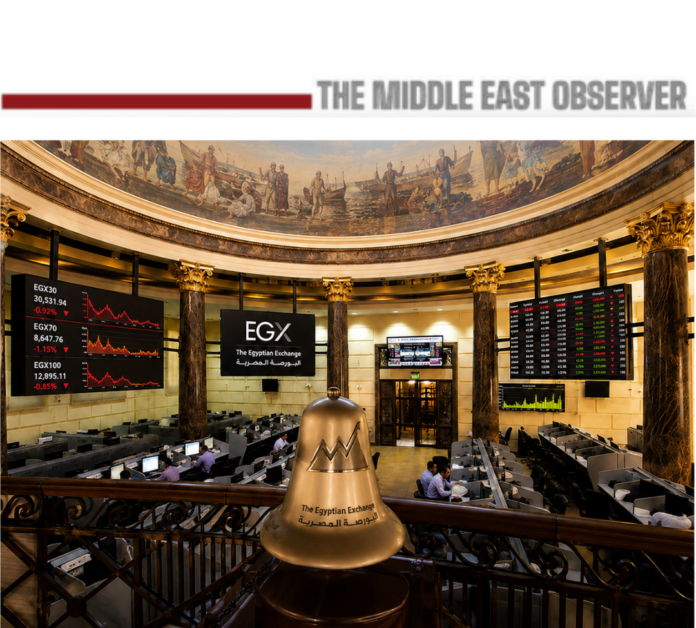
While the benchmark EGX30 index fell 0.93% to close at 52,164 points, the broader story emerging from Portfolio Egypt 2026 and recent corporate announcements points to a potential expansion cycle for Egypt’s capital markets, driven by new listings, private-sector participation and improving external liquidity.
Market capitalization declined by approximately EGP 26 billion to EGP 3.754 trillion, while losses extended across all major indices. The EGX70 index of small- and mid-cap stocks fell 0.65% to 15,349 points, the EGX100 lost 0.68% to 21,213 points, the EGX33 Sharia Index dropped 1.65%, and the EGX35-LV declined 0.95%.
Despite the decline, trading activity remained robust. Turnover reached approximately EGP 9.25 billion through nearly 213,000 transactions, suggesting the session reflected profit-taking and portfolio rebalancing rather than a broad withdrawal of investor interest.
Arab investors led net sales at approximately EGP 186.8 million, followed by foreign investors with EGP 143 million and Egyptian investors with EGP 43.6 million.
The pullback came only days after foreign investors returned strongly to Egypt’s treasury-bill market, recording net purchases of roughly $2.3 billion. At the same time, sovereign credit-default swap premiums continued to ease, indicating improving international perceptions of Egypt’s sovereign-risk profile and supporting confidence in the country’s ability to attract capital.
Among the session’s top gainers, Lotus for Agricultural Investments and Development advanced 13%, while Tycoon Holding Company for Financial Investments gained 11.74% and Export Development Bank of Egypt rose 6.97%. On the downside, Aspire Capital Holding for Financial Investments fell 11.36%, Egyptian for Tourism Resorts lost 11.28%, and El Shams Housing & Urbanization declined 5.75%.
IPO Pipeline Gains Momentum
One of the most significant developments came from Qalaa Holdings founder Ahmed Heikal, who disclosed that he had increased his stake in Citadel Capital Partners, the principal shareholder of Qalaa Holdings, to 60%.
Heikal said the group’s immediate focus remains debt reduction following the expected repayment of the main debt facility of the Egyptian Refining Company by the end of June. The company is also preparing the listing of the National River Ports Management Company later this year, followed by potential offerings of ASEC Automation and Dina Farms.
Separately, the planned listing of Banque du Caire has been postponed until the fourth quarter of 2026, according to Egypt’s State Ownership Unit, although interest from international investors remains strong.
Together, these developments suggest Egypt could be entering a new cycle of capital-market expansion. Planned offerings span banking, petroleum, logistics, food production, industrial technology and transportation, supporting government efforts to deepen market liquidity and expand private-sector participation.
The emerging pipeline is closely aligned with Egypt’s State Ownership Policy, which seeks to attract private investment and broaden the role of capital markets in financing economic growth.
Gulf Support Strengthens External Position
Beyond equities, investors monitored developments affecting Egypt’s financial position. Kuwait renewed its $2 billion deposit at the Central Bank of Egypt for an additional year, while Egypt’s foreign-exchange reserves rose to $53.13 billion in May.
The government is also targeting up to $4 billion in international bond issuance during fiscal year 2026/27 as part of plans to cover external financing requirements estimated at $8-9 billion.
At the same time, Egypt continues to face fiscal challenges. The budget deficit widened to 4.2% of GDP during the first half of 2025, debt-servicing costs increased by 34.6%, and the Central Bank recently trimmed its economic growth forecasts. The contrast highlights an economy benefiting from stronger external financing conditions while continuing to address structural fiscal pressures.
Corporate Expansion Continues
Corporate growth plans also remained in focus. Fawry said it intends to invest between EGP 1.5 billion and EGP 2.5 billion this year, including acquisitions of two or three companies, while its consumer-finance portfolio has reached approximately EGP 3 billion.
Meanwhile, Talaat Moustafa Group announced discussions with Saudi Arabia’s Public Investment Fund regarding major real-estate developments in Riyadh, Jeddah, Madinah and Makkah, underscoring the growing regional footprint of Egyptian corporates.
Market View
The more important signal for investors may not have been the day’s decline, but the volume of corporate activity emerging around the market. Planned listings, debt-reduction programmes, regional expansion strategies and continued Gulf financial support point to a capital market that is becoming broader, deeper and more diversified even as short-term trading remains volatile.
While profit-taking weighed on share prices, confidence in the long-term growth potential of Egypt’s capital markets appears intact. Prospective listings from Qalaa Holdings subsidiaries, the eventual offering of Banque du Caire and anticipated petroleum-sector flotations collectively indicate that the exchange could see its strongest pipeline of new listings in years.
The challenge now is execution. Sustaining liquidity, attracting institutional investors and successfully bringing new issuers to market will determine whether Egypt’s capital-market expansion translates into a lasting increase in investment opportunities and market depth.
