
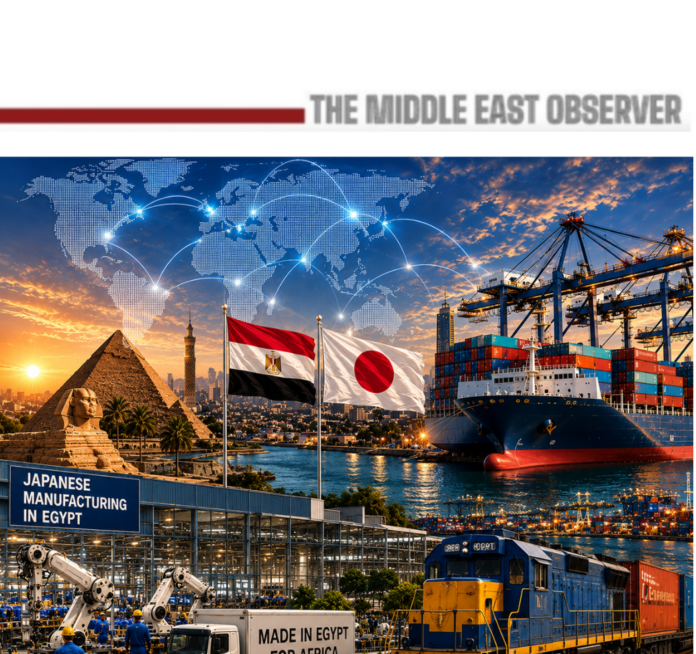
Egypt and Japan have moved to deepen their strategic partnership, signing a preliminary framework in Tokyo as Cairo seeks to position itself as a manufacturing and logistics base for Japanese companies looking beyond traditional Asian supply chains.
The framework was signed during the third round of the Egypt-Japan strategic dialogue between Egyptian Foreign Minister Badr Abdelatty and Japanese Foreign Minister Toshimitsu Motegi. Japan’s foreign ministry said the two sides signed memoranda covering the strategic partnership framework and cooperation between the two foreign ministries, including diplomatic training.
The talks build on the elevation of Egypt-Japan relations to a strategic partnership in April 2023 and come as Cairo attempts to convert long-standing development ties with Tokyo into broader investment, industrial and Africa-focused cooperation.
Abdelatty used the dialogue to promote Egypt’s investment climate, its free-trade access to Arab, African and European markets, and incentives in the Suez Canal Economic Zone. The pitch reflects Egypt’s wider effort to attract manufacturers seeking lower-cost production bases and shorter routes into Europe, Africa and the Middle East.
Japan’s interest is also shifting. Tokyo has been expanding its Africa strategy through TICAD, including a 2025 proposal for an economic zone linking the Indian Ocean and Africa, supported by $5.5bn in loans with the African Development Bank. Egypt is seeking to present itself as a natural partner in that strategy, offering industrial zones, Red Sea and Mediterranean connectivity, and diplomatic networks across Africa.
The commercial base remains modest but increasingly active. Egypt’s investment authority said in 2025 that 87 Japanese companies were operating in the country and that Cairo aimed to double Japanese investment in the next phase. JETRO has also led business missions to Egypt, including a 2024 delegation of 23 Japanese companies and government agencies covering engineering, trading, equipment, power, infrastructure, finance and insurance.
Education and human-capital development remain the most established pillars of the relationship. JICA says Japan-Egypt cooperation began in 1954 and has expanded across health, education, infrastructure and tourism. Japanese-backed projects include Egypt-Japan Schools, the Egypt-Japan University of Science and Technology, and support linked to the Grand Egyptian Museum.
The two sides also discussed trilateral cooperation in Africa, including peacebuilding and capacity-building through the Cairo International Center for Conflict Resolution, Peacekeeping and Peacebuilding. In 2025, Japan, UNDP and CCCPA launched a project to strengthen African peacebuilding and peacekeeping capacities.
The latest framework does not yet represent a final presidential-level agreement. But it signals a broader shift in the relationship: from aid-led cooperation toward a more strategic economic partnership linking Japanese capital and technology with Egypt’s ambition to become a regional production, logistics and Africa-access platform.