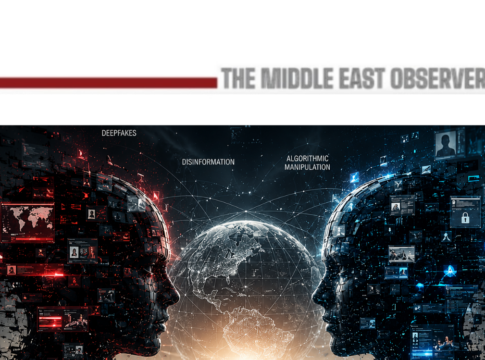
Artificial intelligence is increasingly emerging not merely as a technological breakthrough, but as the central infrastructure through which information, influence and institutional power are being reorganised globally. What began as competition over social media visibility and search engine rankings is evolving into a much broader struggle over datasets, cloud infrastructure, informational ecosystems and the machine-learning architectures through which AI systems interpret reality itself.
The shift marks the beginning of a new geopolitical contest in which strategic influence may depend less on controlling media platforms directly and increasingly on shaping the informational environments feeding artificial intelligence systems. Analysts argue that the global race surrounding AI is no longer solely about technological leadership, but about determining which institutions, archives, datasets and narratives become embedded within the knowledge structures powering machine-generated outputs.
The issue gained renewed attention following reports that former Trump strategist Brad Parscale had reportedly been hired for a campaign aimed at improving how AI platforms portray Israel. According to Axios, the initiative focused on optimising online content for systems including ChatGPT, Claude and Google Gemini, while reportedly using AI visibility-testing tools to evaluate how narratives surfaced inside machine-generated responses.
The episode illustrates the emergence of what analysts increasingly describe as “generative engine optimisation” (GEO) — a rapidly developing practice designed not simply to influence human audiences, but to shape the informational architectures guiding AI retrieval, summarisation and citation systems. Unlike traditional search engine optimisation, which sought visibility through clicks and web traffic, GEO aims to increase the probability that AI systems retrieve, prioritise and legitimise specific narratives, institutional perspectives and datasets as authoritative sources.
The implications extend far beyond politics alone. Analysts increasingly believe GEO may fundamentally reshape the economics of publishing, journalism, academic research and institutional archives. In the emerging AI economy, visibility may no longer depend primarily on audience reach or platform traffic, but on whether datasets, repositories and proprietary knowledge systems become integrated into the retrieval environments underpinning large language models.
This transition is rapidly elevating multilingual archives, licensed databases and authoritative institutional repositories into strategic assets within the next phase of the digital economy. As AI systems increasingly mediate information discovery, institutions capable of controlling trusted datasets and verified knowledge infrastructures may gain disproportionate influence over how information is produced, distributed and legitimised globally.
The debate surrounding AI bias in coverage of the Israeli-Palestinian conflict has become one of the clearest illustrations of how informational asymmetries evolve inside machine-learning systems. Critics and researchers argue that many foundational AI models rely heavily on English-language internet archives, Western institutional reporting and historical datasets that have traditionally framed Middle East developments primarily through security and geopolitical lenses.
Researchers note that large language models do not independently interpret political realities, but instead process statistical relationships between enormous quantities of text. Repeated exposure to narratives centred on terrorism, security threats and immediate conflict dynamics may therefore algorithmically reinforce simplified framings while underweighting broader historical, humanitarian and regional contexts.
The informational struggle extends well beyond initial model training. Modern AI systems are increasingly shaped through multiple interconnected layers including retrieval systems, live web integration, ranking algorithms, reinforcement learning, licensing agreements and institutional archives, creating multiple stages where visibility, discoverability and informational authority influence what machines ultimately present as legitimate knowledge.
Researchers at Stanford Human-Centered Artificial Intelligence (HAI) have warned that growing concentration over AI training data, computational infrastructure and information retrieval systems could significantly reshape how knowledge is produced, distributed and legitimised globally over the coming decade.
The implications are increasingly extending into the future structure of labour and human expertise itself. Business leaders and technology analysts argue that while AI may automate substantial portions of repetitive knowledge work, the strategic importance of human judgment, contextual reasoning and institutional trust could become even more valuable in highly automated environments.
In remarks cited by Fast Company, entrepreneur Aaron Levie argued that AI is likely to absorb the “first 80%” of many professional tasks — including coding, summarisation, repetitive analysis and information processing — while leaving the highest-value 20% dependent on human judgment, strategic interpretation, relationship capital and decision-making under uncertainty.
That emerging “80/20” dynamic may fundamentally reshape the economics of trust itself. As AI commoditises execution and automates routine analytical work, competitive advantage may increasingly shift toward institutions capable of producing credible analysis, proprietary datasets, specialised expertise and trusted contextual interpretation. In sectors such as journalism, consulting, legal services, academic research and intelligence analysis, the premium layer of value may increasingly reside not in raw information generation, but in verification, credibility and interpretive authority.
The transition is already triggering a broader strategic battle over AI discoverability. Publishers, governments, corporations and research institutions are increasingly recognising that future influence may depend on whether their archives, datasets and informational ecosystems become embedded within AI retrieval systems capable of shaping how billions of users access knowledge.
Technology companies insist safeguards are expanding. OpenAI said it had disrupted dozens of covert influence operations since 2024, while developers including Anthropic and Google DeepMind continue strengthening alignment systems aimed at reducing misinformation, synthetic manipulation and coordinated abuse.
Regulators are also beginning to react. The European Union’s AI Act introduces a risk-based framework governing artificial intelligence amid mounting concern that generative AI could accelerate disinformation, synthetic political influence operations and broader informational instability.
The broader implication is that artificial intelligence is no longer merely transforming how information is consumed; it is restructuring the global architecture through which knowledge, legitimacy and influence are constructed. In the AI era, power may increasingly belong not only to those controlling platforms directly, but to those shaping the datasets, informational ecosystems and institutional trust systems through which machines interpret the world itself.